Tutorial

GCSE History: Spain reaches the Americas, c1490–1512

This deck covers the initial phase of Spanish exploration as required by the Pearson Edexcel specification. It focuses on the motivations for exploration, including Spain's 'crusading spirit' and Queen Isabella's role; Columbus's first voyage in 1492; the initial contact with Indigenous peoples (Tainos and Caribs); the rivalry with Portugal leading to the Treaty of Tordesillas; and the establishment of the first Spanish settlements and imperial policies in the Caribbean up to 1512.
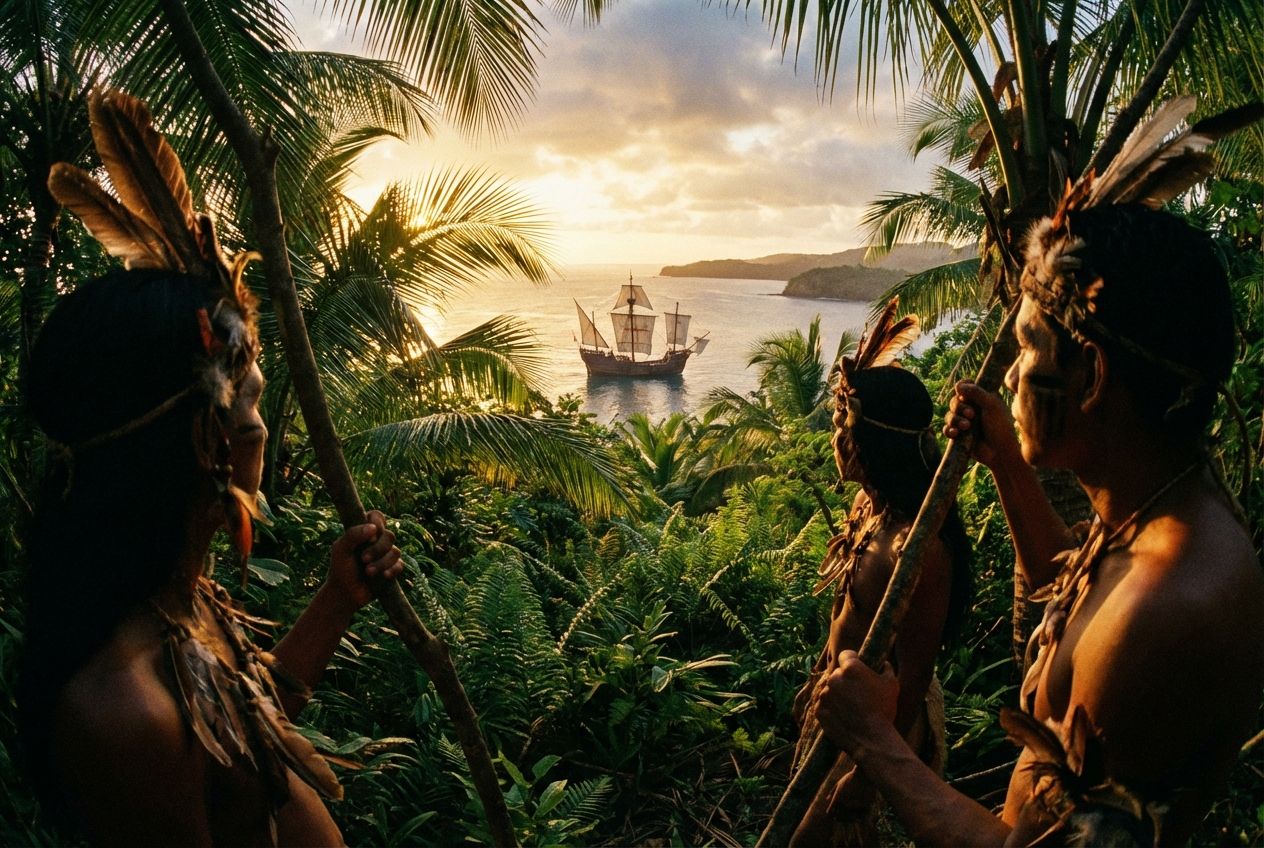
A dramatic wide-angle photograph from the perspective of indigenous Taino people, hidden amongst the dense, tropical foliage of a pristine Caribbean island. In the distance, a 15th-century Spanish caravel sails slowly towards the shore under a dramatic, golden dawn sky. The scene captures a moment of quiet observation and the dawn of a new era, composed for a 3:2 landscape frame.

Management & Tools

Deck Contents

27 Cards
Lesson#1
Welcome to this deck on Spain's arrival in the Americas. We'll explore why Spain launched its voyages of discovery, focusing on the year 1492, which was a pivotal moment for the country. You'll learn about Christopher Columbus, his famous first voyage, and the initial, dramatic encounters between Europeans and the Indigenous peoples of the Caribbean. This is essential knowledge for your GCSE History exam, helping you explain the causes and consequences of the Spanish Empire.
Lesson#2
To understand Spain's drive for exploration, we have to look at the situation in 1492. For centuries, Spain had been engaged in a war to drive Muslim rulers, known as the Moors, out of the Iberian peninsula. This long war was called the Reconquista, or 'reconquest'. When it finally ended in 1492 with the capture of Granada, it left Spain with a powerful army and a strong 'crusading spirit' – a belief that they had a religious duty to spread Catholicism. For your exam, this crusading spirit is a key motivation you can use to explain why Spain was so driven to explore and convert new lands.
Quiz#3
What was the name for the centuries-long conflict in Spain to drive out the Muslim Moors, which ended in 1492?

The Reconquista

Lesson#4
The rulers of Spain, Queen Isabella of Castile and King Ferdinand of Aragon, were deeply religious. Isabella in particular was a devout Catholic and saw it as her mission to spread Christianity. This religious zeal was a powerful personal motivation for her to sponsor risky voyages of exploration. At the same time, Spain was in a fierce economic competition with its neighbour, Portugal, which was building a trading empire along the coast of Africa. Finding a new sea route to the rich spice markets of Asia was a chance to gain immense wealth and power.
Quiz#5
Besides economic gain, what was Queen Isabella's primary religious motivation for sponsoring exploration?

to spread Christianity

Quiz#6
In the late 15th century, which European country was Spain's main rival for exploration and trade routes?

Portugal

Login to View Content

Create a free account or log in to see all 27 cards and start studying this deck.

Learn GCSE History: Spain reaches the Americas, c1490–1512 differently

Auracle is an audio-first learning platform built for busy people. Memorize anything without looking at a screen.

Hands-Free Learning

Listen, interact, and review cards entirely through audio. Perfect for commuting, walking, or at the gym.

Spaced Repetition

Auracle uses a scientific algorithm to schedule your reviews at the optimal time, ensuring you never forget what you learn.

Learn how it works

Ready to start the GCSE History: Spain reaches the Americas, c1490–1512 audio deck?