Tutorial

GCSE A Christmas Carol: Dickens' Message and Victorian Context

This deck introduces Charles Dickens' 'A Christmas Carol', focusing on the author's purpose and the essential social and historical context of Victorian England. It covers key concepts like the 1834 Poor Law, Malthusian theory, and the contrast between poverty and wealth, providing the foundational knowledge needed to analyse the novella's characters and themes.
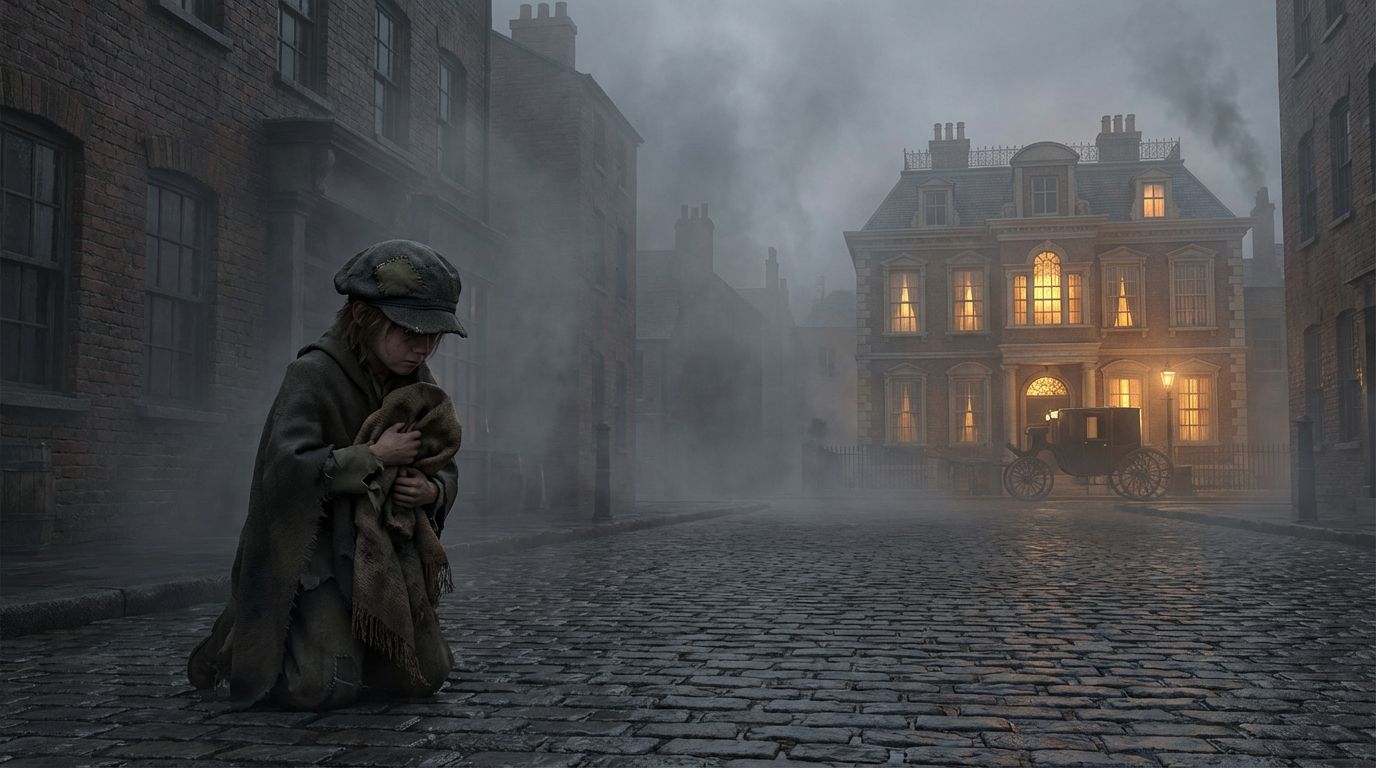
A dramatic, wide-angle photograph of a misty, grimy Victorian London street, where a lone, ragged child shivers in the foreground, while in the hazy distance, the warm glow of a grand, opulent house spills from its windows, emphasizing the stark contrast between wealth and poverty.

Management & Tools

Deck Contents

19 Cards
Lesson#1
In this deck, we'll explore the world of Victorian England to understand why Charles Dickens wrote 'A Christmas Carol'. We will look at his main message, the harsh conditions for the poor, and the popular ideas that influenced characters like Scrooge. This contextual knowledge is essential for a top-grade analysis of the novella in your GCSE exam.
Lesson#2
Charles Dickens wasn't just writing a festive ghost story. He was a passionate social critic, deeply angered by the poverty and inequality he saw in London. He wanted 'A Christmas Carol' to be a powerful wake-up call to the wealthy. He said he wanted to strike a 'sledge-hammer blow' on behalf of the poor. His primary purpose was to use this story to challenge selfish attitudes and inspire real social change, encouraging his readers to take responsibility for those less fortunate.
Quiz#3
What was Charles Dickens' primary purpose for writing 'A Christmas Carol'?

to inspire social change

Quiz#4
In his letters, what powerful tool did Dickens say he wanted to strike on behalf of the poor with 'A Christmas Carol'?

a sledge-hammer blow

Lesson#5
To understand Dickens' message, it's helpful to know the term 'allegory'. An allegory is a story where the characters and events are symbols for bigger, abstract ideas. 'A Christmas Carol' is a powerful allegory. Scrooge isn't just one miserable old man; he represents the selfish, ignorant attitudes of the wealthy Victorian upper class. His transformation from miser to philanthropist is an allegory for social redemption, showing Dickens' belief that society itself could change for the better if people opened their hearts.
Quiz#6
What is the literary term for a story in which characters and events are symbols for abstract ideas?

allegory

Login to View Content

Create a free account or log in to see all 19 cards and start studying this deck.

Learn GCSE A Christmas Carol: Dickens' Message and Victorian Context differently

Auracle is an audio-first learning platform built for busy people. Memorize anything without looking at a screen.

Hands-Free Learning

Listen, interact, and review cards entirely through audio. Perfect for commuting, walking, or at the gym.

Spaced Repetition

Auracle uses a scientific algorithm to schedule your reviews at the optimal time, ensuring you never forget what you learn.

Learn how it works

Ready to start the GCSE A Christmas Carol: Dickens' Message and Victorian Context audio deck?