Tutorial

GCSE History: c1700–c1900: Warfare and British society in the eighteenth and nineteenth centuries

This deck covers the transformation of warfare by industrialisation between 1700 and 1900. It explores new weaponry, transport, army reforms, and the changing public perception of war due to new media, with case studies on the Battles of Waterloo and Balaclava.
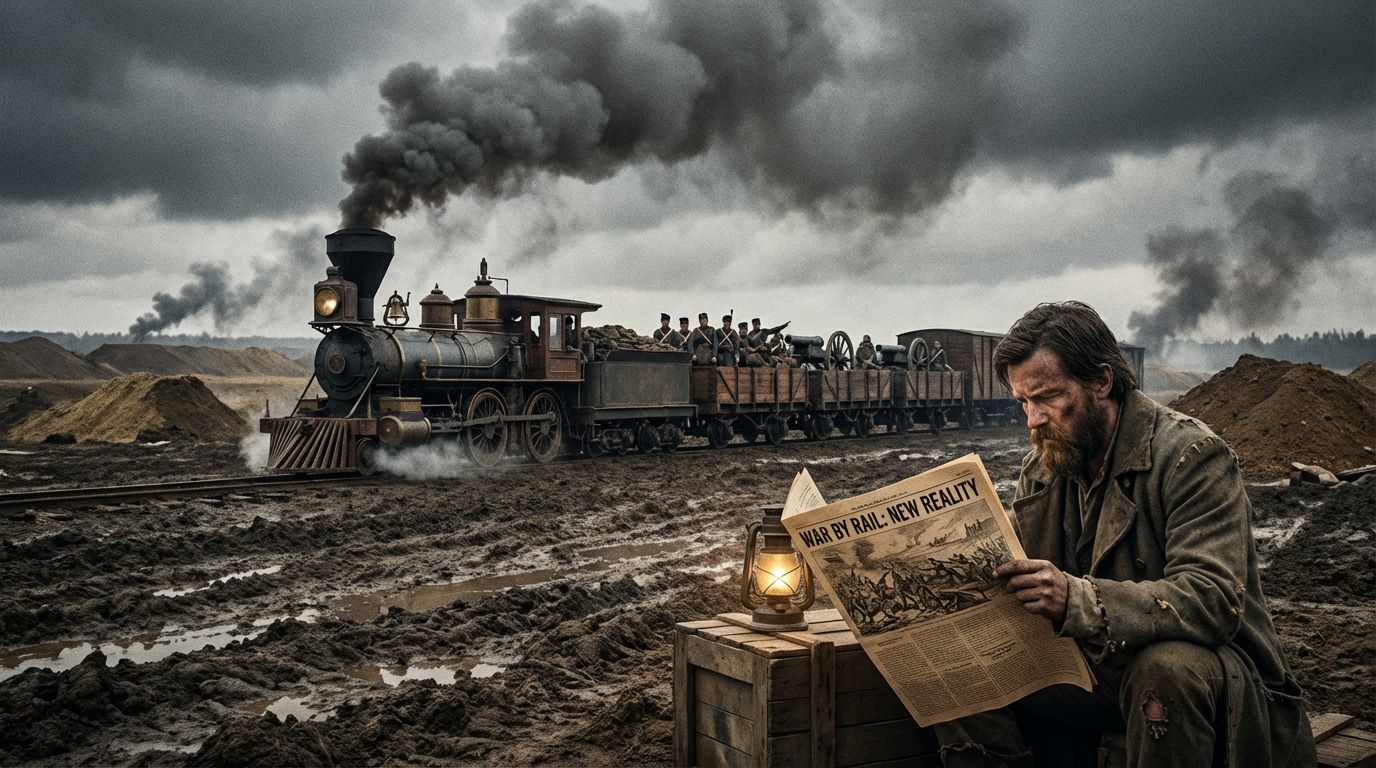
A dramatic, wide-angle photograph set in a 19th-century battlefield. In the mid-ground, a powerful steam locomotive pulls a train laden with British soldiers and heavy artillery across a vast, muddy landscape under an overcast sky. In the foreground, a Victorian-era war correspondent, illuminated by a flickering lantern, intently studies a freshly printed newspaper featuring a stark war image, conveying the new reality of industrialised conflict brought home by media.

Management & Tools

Deck Contents

39 Cards
Lesson#1
Welcome to this deck on warfare and British society from 1700 to 1900. This period saw one of the biggest transformations in history: the Industrial Revolution. We'll explore how factories, steam power, and mass production completely changed the army, its weapons, and how wars were fought. We'll also look at major reforms that created a more professional army and see how, for the first time, newspapers and photography brought the brutal reality of war home to the public. Finally, we'll analyse two famous case studies: the Battle of Waterloo and the Battle of Balaclava.
Lesson#2
Before the 18th century, armies were equipped with weapons made by skilled craftsmen, one at a time. The Industrial Revolution changed all of that. Factories could now mass-produce weapons, ammunition, and uniforms on an enormous scale. This meant larger armies could be equipped more quickly and with more standardised gear. For your exam, industrialisation is a key factor you can use to explain the rapid changes in the nature of warfare during this period.
Quiz#3
What major societal change, involving factories and mass production, transformed warfare in the 18th and 19th centuries?

Industrialisation

Lesson#4
Industrialisation led to huge advances in weaponry. The smoothbore musket, which was inaccurate over long distances, was replaced by the rifle. Rifles had grooves, or 'rifling', inside the barrel that made the bullet spin, giving it much greater accuracy and range. The invention of the Minie bullet in the 1840s made rifles much faster to load. At the same time, new industrial techniques allowed for the creation of much larger and more powerful heavy artillery, capable of firing explosive shells over several kilometres.
Quiz#5
What type of firearm, with a grooved barrel for accuracy, replaced the smoothbore musket?

Rifle

Quiz#6
What invention, a type of bullet, made rifles much faster to load in the mid-19th century?

Minie bullet

Login to View Content

Create a free account or log in to see all 39 cards and start studying this deck.

Learn GCSE History: c1700–c1900: Warfare and British society in the eighteenth and nineteenth centuries differently

Auracle is an audio-first learning platform built for busy people. Memorize anything without looking at a screen.

Hands-Free Learning

Listen, interact, and review cards entirely through audio. Perfect for commuting, walking, or at the gym.

Spaced Repetition

Auracle uses a scientific algorithm to schedule your reviews at the optimal time, ensuring you never forget what you learn.

Learn how it works

Ready to start the GCSE History: c1700–c1900: Warfare and British society in the eighteenth and nineteenth centuries audio deck?