Tutorial

GCSE History: The development of the civil rights movement, 1954–60

This deck covers the early years of the US civil rights movement from 1954 to 1960. It examines the system of segregation, the work of key organisations, landmark legal cases like Brown v. Topeka, the events at Little Rock, the Montgomery Bus Boycott, and the opposition faced by activists.
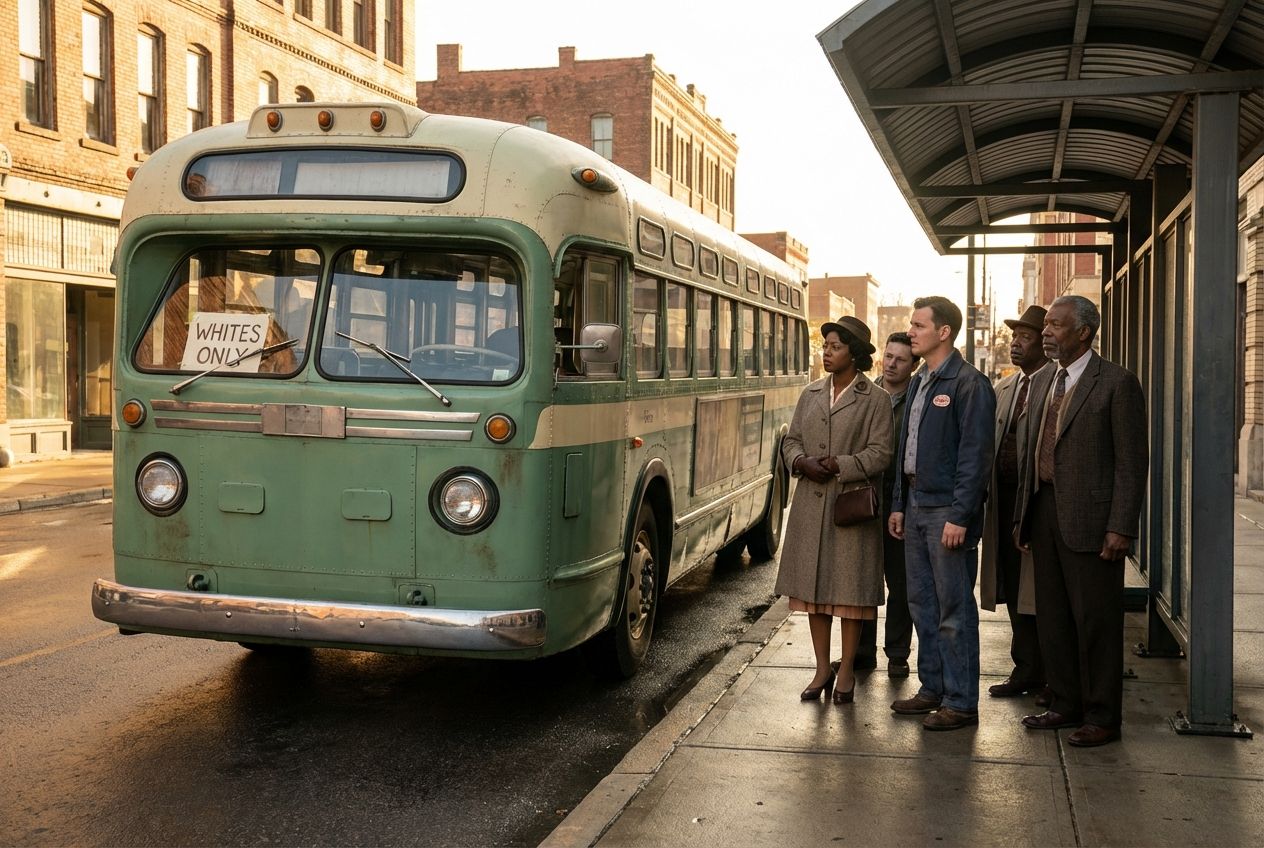
A dramatic, wide-angle photograph of an old American public bus from the 1950s, parked at a downtown city bus stop. A "Whites Only" sign is clearly visible on the front or side of the bus. A small, diverse group of people, dressed in period clothing, stand at the bus stop, looking towards the bus with expressions of quiet determination, hinting at the beginning of the civil rights movement. The scene is set in warm, late afternoon light, composed for a 3:2 landscape frame.

Management & Tools

Deck Contents

39 Cards
Lesson#1
This deck covers the development of the civil rights movement in the USA between 1954 and 1960. You'll learn about the system of segregation in the Southern states, the work of early civil rights groups, and the key events that began to challenge racial inequality, such as the Brown versus Topeka court case and the Montgomery Bus Boycott. We'll also explore the fierce opposition the movement faced.
Lesson#2
In the early 1950s, particularly in the Southern states, American society was deeply segregated. This system was enforced by a collection of state and local laws known as 'Jim Crow' laws. These laws mandated separate facilities for Black and white Americans in almost all aspects of public life, including schools, hospitals, transport, and even water fountains. The principle was 'separate but equal', but in reality, the facilities for Black Americans were almost always inferior.
Quiz#3
What was the collective name for the laws that enforced racial segregation in the Southern states of the USA?

Jim Crow laws

Quiz#4
What legal principle, established in 1896, did Jim Crow laws rely on to justify segregation?

separate but equal

Lesson#5
Beyond segregation, Black Americans faced widespread discrimination and the denial of basic rights. The most significant of these was the denial of the right to vote. Southern states used various tactics to prevent Black people from registering to vote, such as poll taxes, which required a fee, and literacy tests, which were often impossible to pass. This systematic disenfranchisement ensured that the white-dominated political structure remained in power.
Quiz#6
What type of test was used in some Southern states to prevent Black Americans from registering to vote?

literacy tests

Login to View Content

Create a free account or log in to see all 39 cards and start studying this deck.

Learn GCSE History: The development of the civil rights movement, 1954–60 differently

Auracle is an audio-first learning platform built for busy people. Memorize anything without looking at a screen.

Hands-Free Learning

Listen, interact, and review cards entirely through audio. Perfect for commuting, walking, or at the gym.

Spaced Repetition

Auracle uses a scientific algorithm to schedule your reviews at the optimal time, ensuring you never forget what you learn.

Learn how it works

Ready to start the GCSE History: The development of the civil rights movement, 1954–60 audio deck?