Tutorial

GCSE History: Life and government in England, 1189–1216

This deck covers the foundational aspects of life in England during the reigns of Richard I and John. It details the feudal system, the role of the Church, the nature of kingship, and the characters of both monarchs. It also examines how England was governed and financed, the structure of society in towns and the countryside, and the specific role and persecution of the Jewish community.
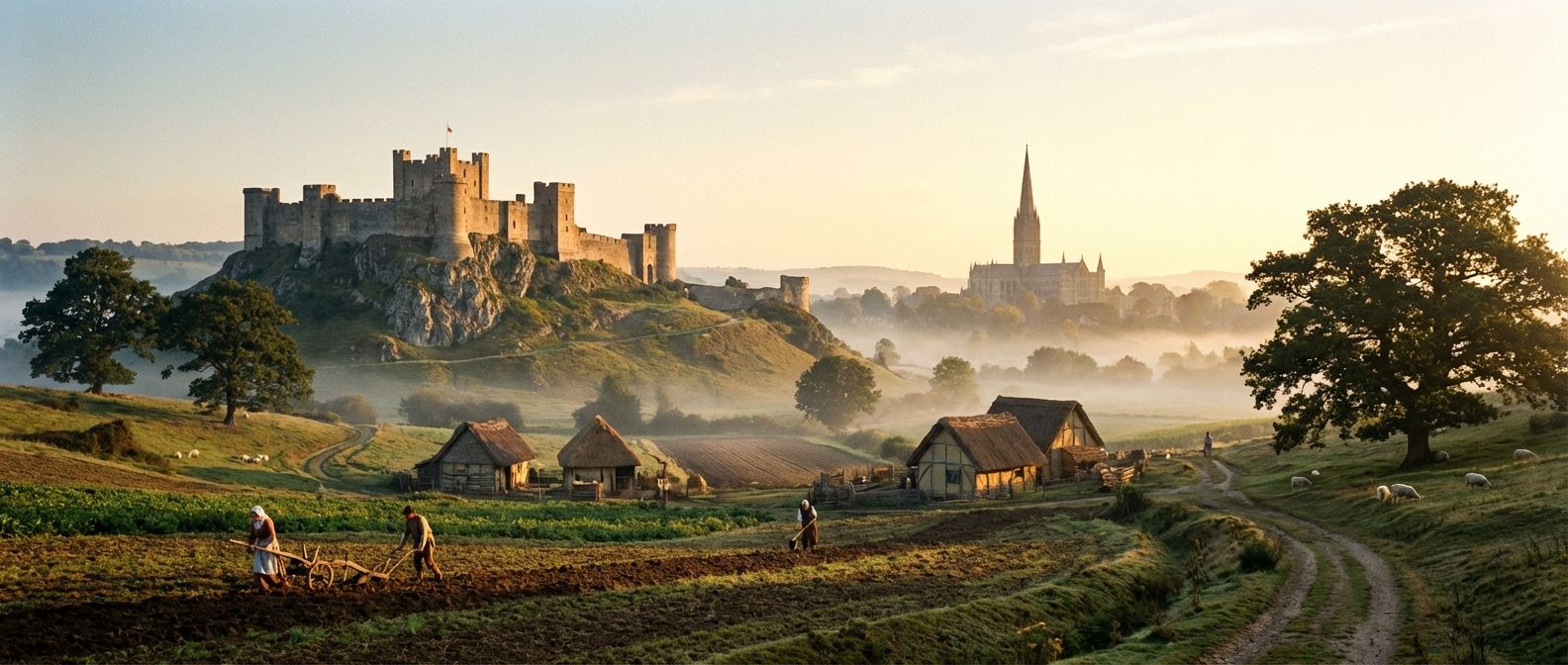
A dramatic wide-angle photograph of a medieval English landscape at dawn, featuring a majestic stone castle perched prominently on a hill in the mid-distance, with the spire of a grand cathedral visible further in the background. In the foreground, a small group of peasants are working the fertile fields, their simple homes nestled amidst rolling hills, all bathed in the soft, golden light of the rising sun.

Management & Tools

Deck Contents

32 Cards
Lesson#1
Welcome to this deck on life and government in England between 1189 and 1216. We'll explore the reigns of two very different kings: Richard the First, known as the Lionheart, and his brother, King John. You'll learn about the structure of society under the feudal system, the immense power of the Church, and how the country was run and financed. This is essential knowledge for your GCSE History exam, helping you understand the foundations of medieval England.
Lesson#2
To understand medieval England, you first need to understand the feudal system. It was a hierarchy based on land ownership and loyalty. At the very top was the king, who owned all the land. He granted large areas of land, known as fiefs, to his most powerful nobles, the tenants-in-chief, in exchange for their loyalty and military support.
Quiz#3
In the feudal system, who was at the top of the hierarchy and owned all the land?

The king

Quiz#4
What was the title for the major barons and bishops who held land directly from the king in the feudal system?

Tenants-in-chief

Lesson#5
In return for their land, tenants-in-chief had to perform a ceremony called homage, where they swore an oath of loyalty to the king. A key part of this was providing a set number of knights for the king's army. This was called knight service. These knights, in turn, were given smaller plots of land by the tenants-in-chief. At the bottom of the system were the peasants, who worked the land in exchange for protection. This was called labour service.
Quiz#6
What is the name of the public ceremony where a vassal swore an oath of loyalty to their lord in the feudal system?

Homage

Login to View Content

Create a free account or log in to see all 32 cards and start studying this deck.

Learn GCSE History: Life and government in England, 1189–1216 differently

Auracle is an audio-first learning platform built for busy people. Memorize anything without looking at a screen.

Hands-Free Learning

Listen, interact, and review cards entirely through audio. Perfect for commuting, walking, or at the gym.

Spaced Repetition

Auracle uses a scientific algorithm to schedule your reviews at the optimal time, ensuring you never forget what you learn.

Learn how it works

Ready to start the GCSE History: Life and government in England, 1189–1216 audio deck?