Tutorial

GCSE History: The American West - Development of the Plains, c1862–c1876

This deck focuses on the rapid development of the Plains following key government acts. It covers the transformative impact of the railroads and the Homestead Act on settlement, the growth of the cattle industry and the life of the cowboy, and the escalating conflict with the Plains Indians, including Red Cloud's War and the Sand Creek Massacre.
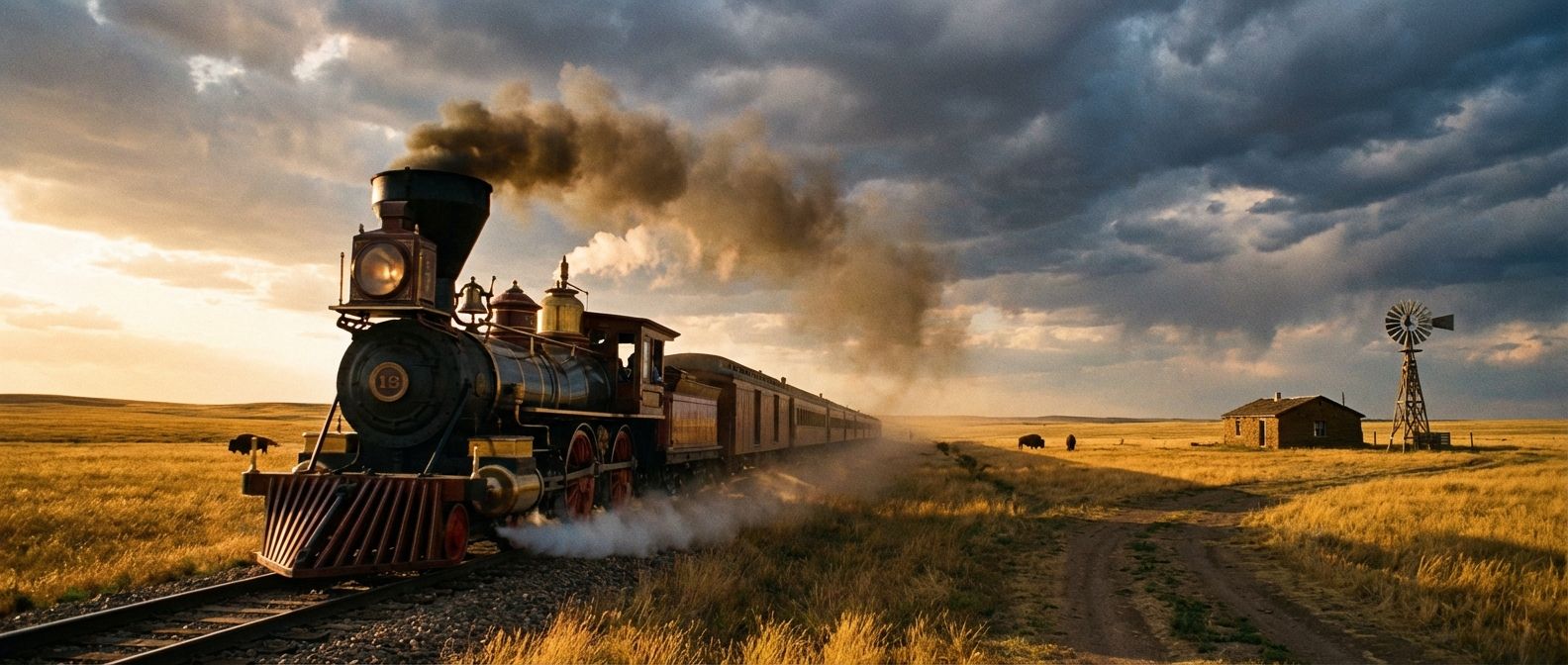
A dramatic, wide-angle photograph of a powerful steam locomotive from the 1870s, pulling a train across the vast, golden American Plains at sunset. In the far distance, a solitary sod house with a functioning windmill stands under a dramatic, cloud-filled sky, conveying both rapid development and the harsh realities of settlement in the American West.

Management & Tools

Deck Contents

40 Cards
Lesson#1
In this deck, we'll explore a period of massive and rapid change on the American Plains, roughly from 1862 to 1876. You'll learn how key government decisions, like the Pacific Railroad Act and the Homestead Act, unleashed a wave of settlement and development. We'll examine the rise of the great cattle ranches, the life of the cowboy, and the struggles of homesteaders trying to build a new life. Crucially, we'll also see how this expansion led to escalating and tragic conflicts with the Plains Indian nations.
Lesson#2
To understand why this rapid development happened in the 1860s, we need to look at the American Civil War, which was fought from 1861 to 1865. Before the war, Southern states in Congress had blocked laws that would encourage settlement in the West. When they left the Union to fight the war, the Northern-dominated government was free to pass laws that would bind the West to the rest of the country. For your exam, this is a key point explaining the timing of these crucial acts.
Quiz#3
What 1862 law authorised the building of the First Transcontinental Railroad?

Pacific Railroad Act

Lesson#4
The government didn't build the railroad itself. Instead, it gave huge incentives to two private companies. The Union Pacific company started building west from Omaha, Nebraska, while the Central Pacific company started building east from Sacramento, California. They were given vast grants of land and government loans for every mile of track they laid, creating a frantic race to see who could build the fastest.
Quiz#5
What were the names of the two companies that built the First Transcontinental Railroad?

Union Pacific and Central Pacific

Lesson#6
The completion of the railroad in 1869 was a turning point. It made migration to the West much faster, cheaper, and safer for settlers. It allowed raw materials to be shipped east and manufactured goods to be shipped west, creating new towns and industries. However, for the Plains Indians, the railroad was a disaster. It brought thousands of settlers onto their land and, most devastatingly, it split the great buffalo herds, making them easier to hunt and disrupting the Indians' entire way of life.

Login to View Content

Create a free account or log in to see all 40 cards and start studying this deck.

Learn GCSE History: The American West - Development of the Plains, c1862–c1876 differently

Auracle is an audio-first learning platform built for busy people. Memorize anything without looking at a screen.

Hands-Free Learning

Listen, interact, and review cards entirely through audio. Perfect for commuting, walking, or at the gym.

Spaced Repetition

Auracle uses a scientific algorithm to schedule your reviews at the optimal time, ensuring you never forget what you learn.

Learn how it works

Ready to start the GCSE History: The American West - Development of the Plains, c1862–c1876 audio deck?