Tutorial

AQA GCSE Spanish Higher Tier: The Present Subjunctive

This deck covers the formation and use of the present subjunctive in Spanish, a key topic for AQA GCSE Higher Tier candidates. You'll learn how to form the subjunctive for regular and irregular verbs, and when to use it with expressions of will, emotion, doubt, and more (WEIRDO).
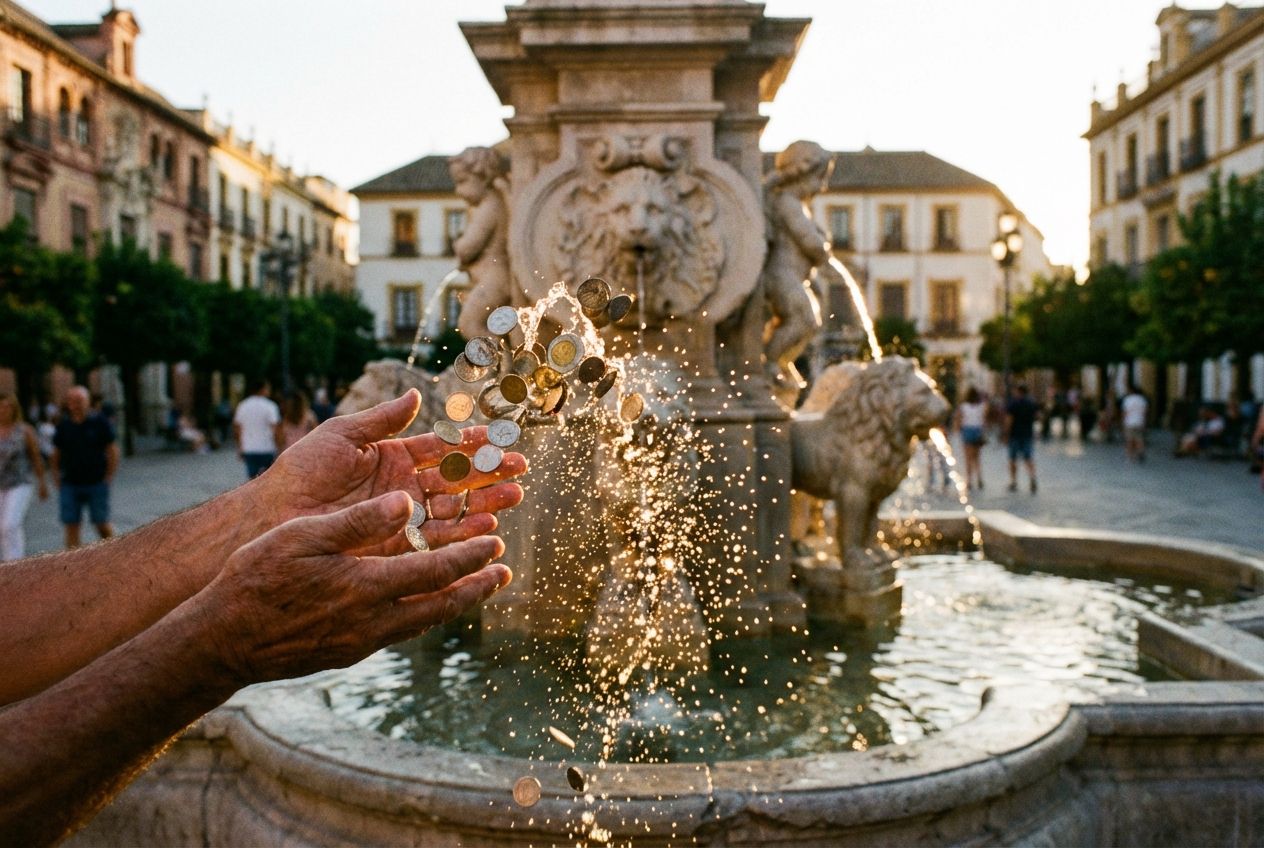
A dramatic close-up photograph of hands gracefully tossing several shimmering coins into a grand, ornate traditional Spanish fountain. The water is illuminated by the warm, golden light of a setting sun, creating sparkling reflections. The background is a softly blurred, atmospheric Spanish plaza, composed for a 3:2 landscape frame.
en-GB es-ES

Management & Tools

Deck Contents

47 Cards
Lesson#1
Welcome to this deck on the present subjunctive in Spanish. This is a crucial topic for Higher Tier GCSE candidates. The subjunctive is a mood, not a tense, and it's used to talk about things that are subjective or uncertain, like wishes, doubts, and emotions. In this deck, we'll learn how to form it for regular and irregular verbs, and then explore the key situations where you must use it.
Lesson#2
First, let's learn the rule for forming the present subjunctive for most verbs. It's a simple three-step process. One: take the 'yo' form of the verb in the present indicative tense. Two: drop the final 'o'. Three: add the 'opposite' ending. This means for A R verbs, you'll add E R endings, and for E R and I R verbs, you'll add A R endings.
Lesson#3
Let's look at regular A R verbs, like 'hablar', which means 'to speak'. The 'yo' form is 'hablo'. We drop the 'o' to get 'habl', and then add the opposite endings, which are: e, es, e, emos, éis, en. So the subjunctive forms are: hable, hables, hable, hablemos, habléis, hablen.
Quiz#4
How do you say 'that I speak' in Spanish, using the present subjunctive?

que hable

Quiz#5
How do you say 'that we speak' in Spanish, using the present subjunctive?

que hablemos

Lesson#6
Now for regular E R and I R verbs. Let's take 'comer', to eat, and 'vivir', to live. The 'yo' forms are 'como' and 'vivo'. We drop the 'o' and add the opposite A R endings: a, as, a, amos, áis, an. So for 'comer' we get: coma, comas, coma, comamos, comáis, coman. And for 'vivir': viva, vivas, viva, vivamos, viváis, vivan.

Login to View Content

Create a free account or log in to see all 47 cards and start studying this deck.

Learn AQA GCSE Spanish Higher Tier: The Present Subjunctive differently

Auracle is an audio-first learning platform built for busy people. Memorize anything without looking at a screen.

Hands-Free Learning

Listen, interact, and review cards entirely through audio. Perfect for commuting, walking, or at the gym.

Spaced Repetition

Auracle uses a scientific algorithm to schedule your reviews at the optimal time, ensuring you never forget what you learn.

Learn how it works

Ready to start the AQA GCSE Spanish Higher Tier: The Present Subjunctive audio deck?