Tutorial

GCSE History: c1500–c1700: The Medical Renaissance in England

This deck covers the Medical Renaissance, focusing on continuity and change in ideas about illness. It explores the rise of a scientific approach through the work of Thomas Sydenham, the impact of the printing press and the Royal Society, and improvements in anatomy due to Vesalius. It includes case studies on William Harvey's discovery of blood circulation and the response to the Great Plague in London in 1665.
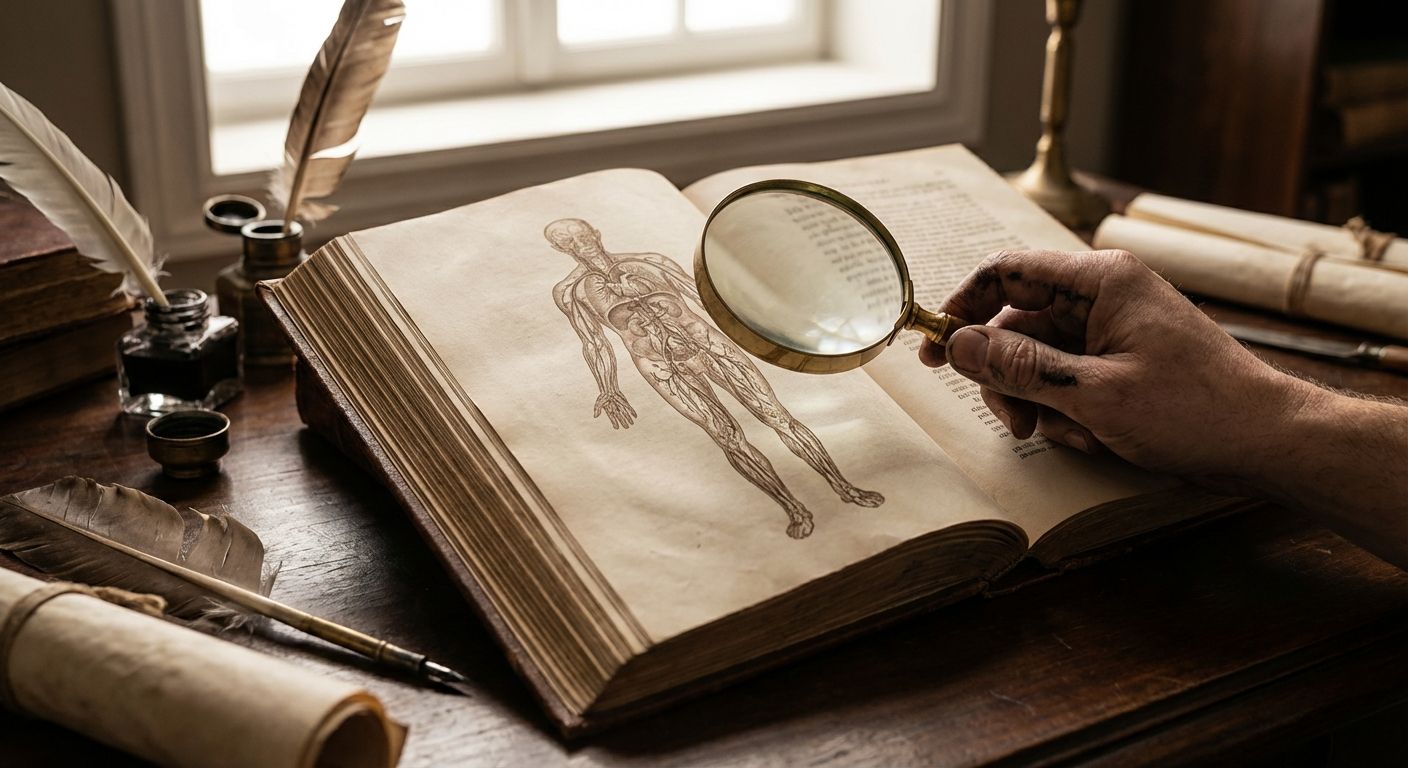
A dramatic, close-up photograph of an antique, leather-bound anatomy book open to a detailed, intricate illustration of the human circulatory system. A hand, perhaps holding a magnifying glass or a quill, is meticulously studying a specific detail on the illuminated page, set on a dark wooden desk. The scene, bathed in soft, natural light, evokes the spirit of scientific discovery and meticulous observation during the Medical Renaissance.

Management & Tools

Deck Contents

33 Cards
Lesson#1
Welcome to this deck on the Medical Renaissance in England, covering the period from around 1500 to 1700. The word 'Renaissance' means rebirth, and this was a time of new ideas in art, science, and medicine. However, for your exam, it's crucial to understand that this was not a complete revolution. Instead, it was a period of slow change, where new scientific thinking began to challenge traditional ideas. We will explore both the important changes and the significant continuities from the medieval period.
Lesson#2
Let's begin with continuity, which means the things that stayed the same. Despite the new discoveries, for most ordinary people, ideas about the causes of illness were almost identical to those in the Middle Ages. The two most important theories that continued to be widely believed were the Theory of the Four Humours and the Miasma Theory.
Quiz#3
What theory, inherited from the medieval period, claimed illness was caused by an imbalance of four liquids in the body?

The Four Humours

Quiz#4
What theory, popular since the ancient Greeks, claimed that disease was spread by bad smells and poisonous vapours in the air?

Miasma theory

Lesson#5
So, continuity was strong. People still prayed when they were sick, and treatments like bloodletting and purging remained common. However, change was happening. The authority of the Church, which had controlled medical learning for centuries, was weakened. This encouraged some thinkers to question the ancient medical texts, especially the work of Galen, and to look for evidence themselves. This marked the beginning of a more scientific approach based on observation and experiment.
Lesson#6
A key figure in this new approach was Thomas Sydenham, an English doctor working in London in the late 1600s. He argued that doctors should rely on their own observations of a patient's symptoms, rather than just reading old books. He would take detailed notes and believed in classifying diseases, much like a botanist classifies plants. For your exam, Sydenham is a perfect example of the move towards a more scientific and clinical approach to medicine.

Login to View Content

Create a free account or log in to see all 33 cards and start studying this deck.

Learn GCSE History: c1500–c1700: The Medical Renaissance in England differently

Auracle is an audio-first learning platform built for busy people. Memorize anything without looking at a screen.

Hands-Free Learning

Listen, interact, and review cards entirely through audio. Perfect for commuting, walking, or at the gym.

Spaced Repetition

Auracle uses a scientific algorithm to schedule your reviews at the optimal time, ensuring you never forget what you learn.

Learn how it works

Ready to start the GCSE History: c1500–c1700: The Medical Renaissance in England audio deck?