Tutorial

GCSE History: Anglo-Saxon England and the Norman Conquest, 1060–66

This deck covers the state of Anglo-Saxon England before the conquest, including its government, society, and economy. It details the succession crisis following Edward the Confessor's death, introducing the rival claimants to the throne. The deck covers the key battles of 1066: Gate Fulford, Stamford Bridge, and Hastings, culminating in an analysis of why William won.
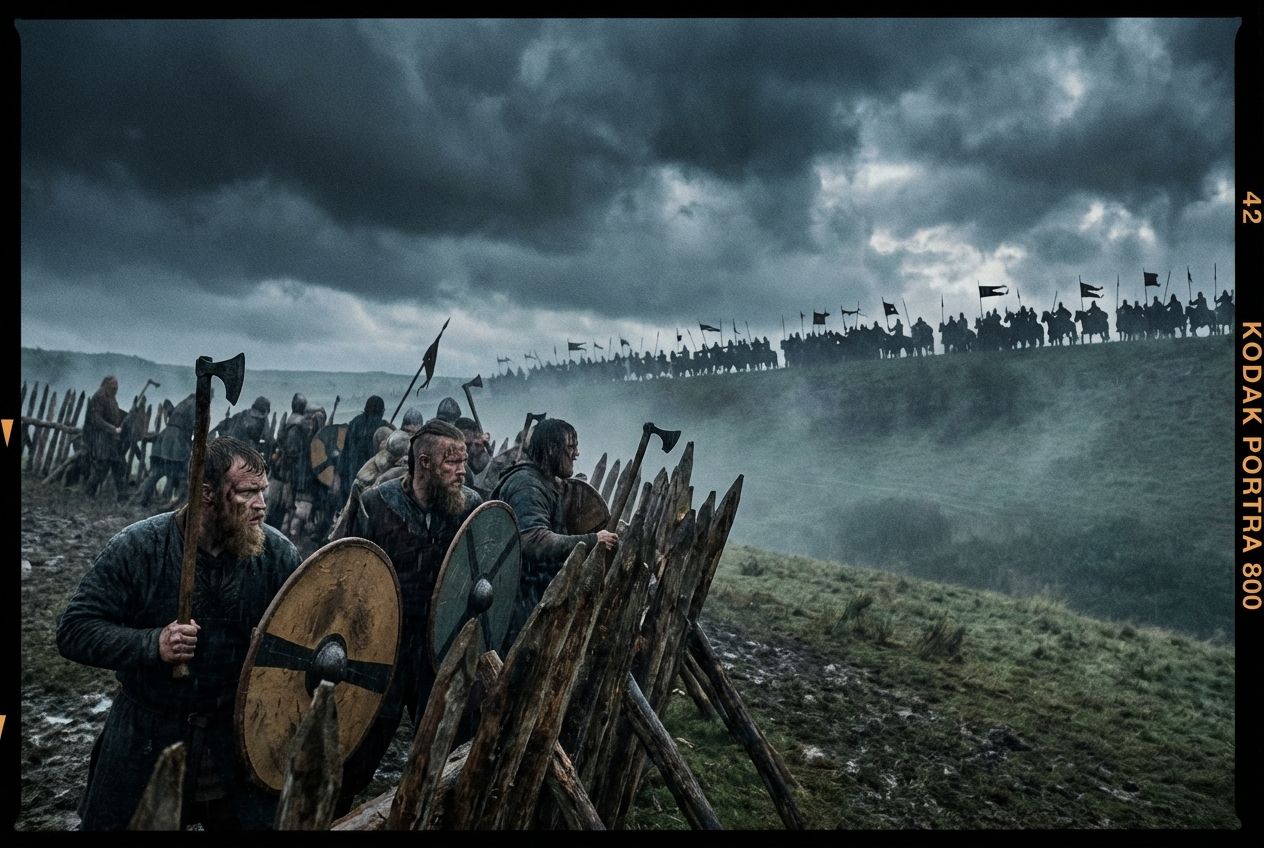
A dramatic, wide-angle photograph captures the tension of impending conflict. In the foreground, a group of Anglo-Saxon warriors, armed with round shields and axes, stand ready behind a sturdy wooden palisade on a hill. In the misty distance, the silhouette of a Norman cavalry charge is just visible on the horizon, under a dramatic, cloudy sky, composed for a 3:2 landscape frame.

Management & Tools

Deck Contents

41 Cards
Lesson#1
Welcome to this deck on Anglo-Saxon England and the Norman Conquest. We'll explore what England was like before 1066, a powerful and well-organised kingdom. Then we'll dive into the dramatic events of that year: the death of a king, a crisis with four claimants to the throne, and three major battles that would change England forever. By the end, you'll understand exactly why William of Normandy was victorious at the Battle of Hastings.
Lesson#2
First, let's look at how Anglo-Saxon England was governed. It was a sophisticated kingdom with a strong monarchy. The king had significant power: he made laws, controlled the minting of coins, and was in charge of the army and fleet. However, he didn't rule alone. He was advised by a council of the most powerful men in the kingdom, the earls and bishops. This council was known as the Witan.
Quiz#3
In Anglo-Saxon England, what was the name of the king's council of leading advisors?

the Witan

Lesson#4
The kingdom was divided into large territories called earldoms, each ruled by a powerful earl on behalf of the king. These earldoms were further divided into shires, which are the basis for many of England's counties today. Each shire had its own court for trying cases and a fortress, known as a burh. Each shire was managed by a king's official called a Shire Reeve, who was responsible for collecting taxes and enforcing the law. This role would later evolve into the sheriff.
Quiz#5
What were the large territories ruled by an earl in Anglo-Saxon England called?

earldoms

Quiz#6
In Anglo-Saxon England, what was the king's official responsible for running a shire called?

Shire Reeve

Login to View Content

Create a free account or log in to see all 41 cards and start studying this deck.

Learn GCSE History: Anglo-Saxon England and the Norman Conquest, 1060–66 differently

Auracle is an audio-first learning platform built for busy people. Memorize anything without looking at a screen.

Hands-Free Learning

Listen, interact, and review cards entirely through audio. Perfect for commuting, walking, or at the gym.

Spaced Repetition

Auracle uses a scientific algorithm to schedule your reviews at the optimal time, ensuring you never forget what you learn.

Learn how it works

Ready to start the GCSE History: Anglo-Saxon England and the Norman Conquest, 1060–66 audio deck?