Tutorial

GCSE Biology: Microscopy and Culturing Microorganisms

Learn the principles of light and electron microscopy, including calculating magnification. Covers the method for Required Practical 1 (using a light microscope) and Required Practical 2 (culturing microorganisms and testing antiseptics or antibiotics).
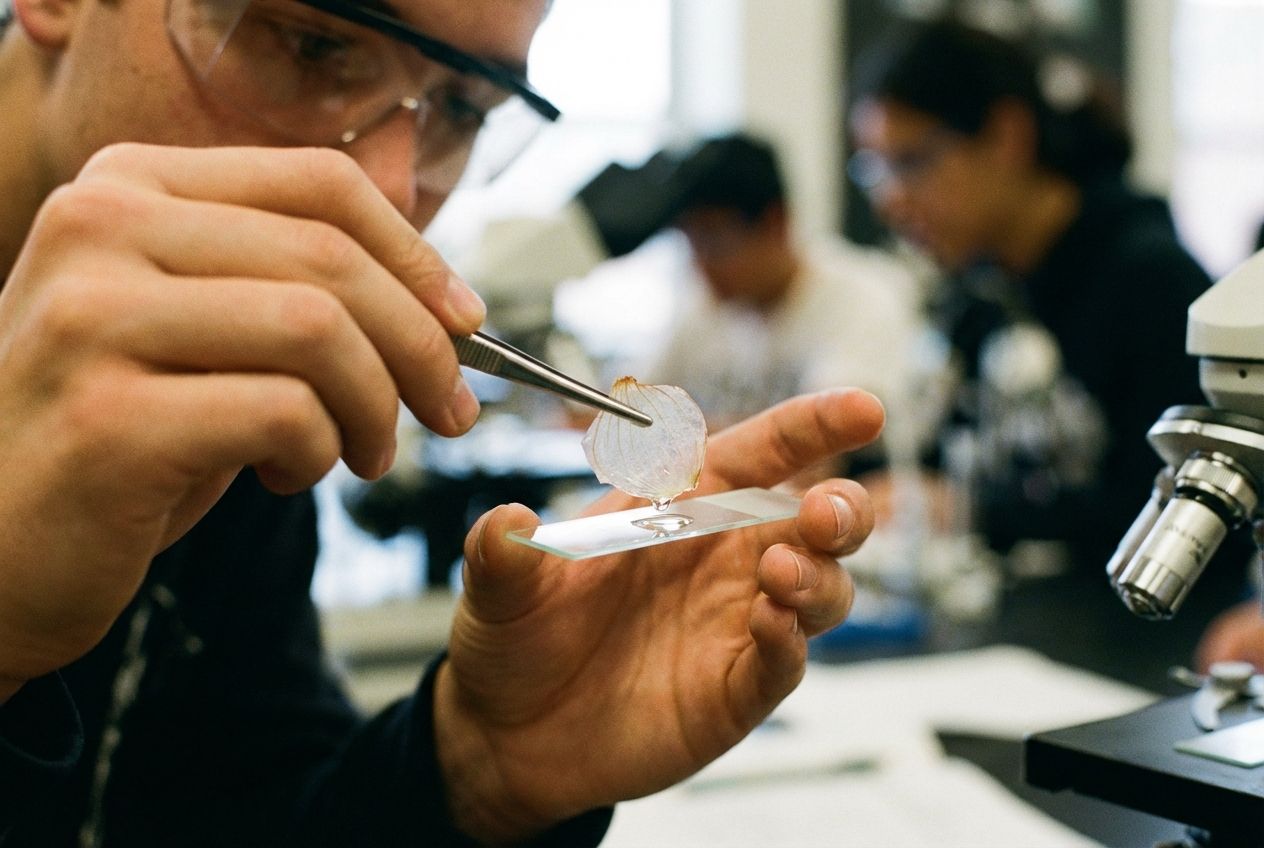
A close-up photograph of a student carefully preparing a microscope slide of a thin, translucent onion skin sample, illuminated by the bright light of a laboratory, with the focus on the delicate process of cell observation.

Management & Tools

Deck Contents

44 Cards
Lesson#1
In this deck, we'll explore the microscopic world. You'll learn about the two main types of microscope, light and electron, and how to calculate magnification. We will also cover two important required practicals: how to use a light microscope to view cells, and how to safely culture microorganisms to test the effectiveness of antiseptics.
Lesson#2
Microscopes are instruments that make objects appear larger. The simplest type is a magnifying glass, but in the lab we use compound light microscopes, which use multiple lenses to achieve higher magnification. The key purpose of any microscope is to magnify an object, making details visible that are too small to see with the naked eye.
Quiz#3
What is the primary function of a microscope?

to magnify objects

Lesson#4
There are two main types of microscope you need to know for your GCSE: light microscopes and electron microscopes. Light microscopes, as the name suggests, work by passing light through a specimen and using glass lenses to focus the light and magnify the image.
Quiz#5
What do light microscopes use to magnify an image?

light and lenses

Lesson#6
Electron microscopes are much more powerful. Instead of light, they use a beam of electrons, which are focused using magnets. This allows them to achieve much higher magnification and also a much better resolution. Resolution is the ability to distinguish between two points that are very close together, meaning you can see things in much finer detail.

Login to View Content

Create a free account or log in to see all 44 cards and start studying this deck.

Learn GCSE Biology: Microscopy and Culturing Microorganisms differently

Auracle is an audio-first learning platform built for busy people. Memorize anything without looking at a screen.

Hands-Free Learning

Listen, interact, and review cards entirely through audio. Perfect for commuting, walking, or at the gym.

Spaced Repetition

Auracle uses a scientific algorithm to schedule your reviews at the optimal time, ensuring you never forget what you learn.

Learn how it works

Ready to start the GCSE Biology: Microscopy and Culturing Microorganisms audio deck?