Tutorial

The Dhamma and the Three Marks of Existence: AQA GCSE Religious Studies Buddhism

Covers the concept of Dhamma as natural law and the Buddha's teaching, dependent arising and the twelve nidanas, and all three Marks of Existence: anicca, anatta, and dukkha. Includes the critical anatta misconception and exam application guidance.
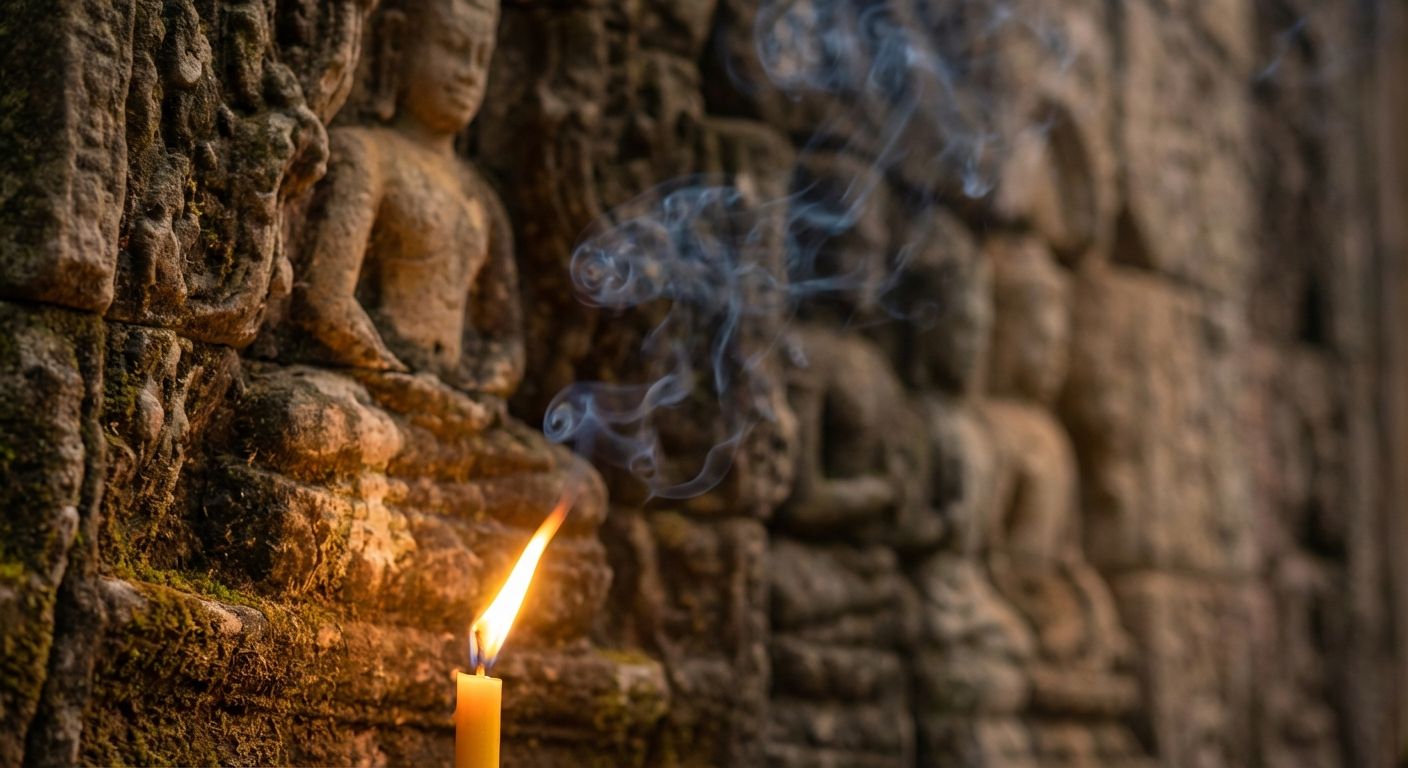
A dramatic, close-up photograph of a single, vibrant candle flame, gently flickering, with subtle tendrils of smoke rising, set against the softly blurred, ancient stone wall of a Buddhist temple at dusk. The warm, golden light illuminates intricate carvings, evoking the ephemeral nature of all existence and the interconnectedness of conditions.

Management & Tools

Deck Contents

39 Cards
Lesson#1
Welcome to this deck on the Dhamma and the Three Marks of Existence. These are some of the most fundamental ideas in all of Buddhism, and they appear constantly in AQA exam questions. By the end of this deck, you will be able to define and explain the Dhamma, describe how all things arise through dependent conditions, and give clear accounts of all three Marks of Existence: anicca, anatta, and dukkha. You will also know a critical distinction about anatta that many students get wrong, and you will know how to use all of this as evidence in your exam answers.
Lesson#2
Let us begin with the Dhamma. The word Dhamma comes from the Pali language, and in Sanskrit it is spelled Dharma. It has two closely related meanings that you need to know for the exam. The first meaning is natural law: the way things actually are, the underlying truth of reality that exists whether or not anyone discovers it. Think of it like the laws of physics. Gravity operated long before Newton described it. In the same way, Buddhists believe the truths the Buddha taught were always true. He did not invent them. He discovered them. The second meaning of Dhamma is the Buddha's teaching itself: the body of doctrine, the path, the instructions he gave to his followers after his Enlightenment. When Buddhists talk about taking refuge in the Dhamma, they mean taking refuge in these teachings as a guide to life and liberation. Both meanings are important, and they are connected: the Buddha's teaching is considered reliable precisely because it accurately describes the way things really are.
Quiz#3
In Buddhism, what Pali term refers both to natural law and to the Buddha's teaching?

Dhamma

Quiz#4
In Buddhism, why is the Dhamma considered reliable as a guide to life?

it describes reality as it is

Lesson#5
Now let us look at one of the most important and intellectually rich ideas in Buddhism: dependent arising, which in Pali is called paticcasamupada. The core claim is this: nothing exists independently. Every single thing that exists arises because of conditions, and it ceases when those conditions cease. The Buddha is said to have expressed this in a simple formula: when this is, that is. When this is not, that is not. From the arising of this comes the arising of that. From the cessation of this comes the cessation of that. This might sound abstract, but think about a flame. A flame exists because of fuel, oxygen, and heat. Remove any one of those conditions and the flame goes out. The flame has no independent existence of its own. Buddhism says the same is true of everything, including you. Your body, your thoughts, your sense of self, all of it arises in dependence on conditions. This teaching is not just a philosophical curiosity. It is the foundation for understanding why suffering arises and how it can end.
Quiz#6
What is the Pali term for the Buddhist teaching that all phenomena arise in dependence on conditions?

paticcasamupada

Login to View Content

Create a free account or log in to see all 39 cards and start studying this deck.

Learn The Dhamma and the Three Marks of Existence: AQA GCSE Religious Studies Buddhism differently

Auracle is an audio-first learning platform built for busy people. Memorize anything without looking at a screen.

Hands-Free Learning

Listen, interact, and review cards entirely through audio. Perfect for commuting, walking, or at the gym.

Spaced Repetition

Auracle uses a scientific algorithm to schedule your reviews at the optimal time, ensuring you never forget what you learn.

Learn how it works

Ready to start the The Dhamma and the Three Marks of Existence: AQA GCSE Religious Studies Buddhism audio deck?