Tutorial

AQA GCSE Physics: Gas Pressure

Explains gas pressure in terms of the collisions of gas particles with the walls of a container. Covers the relationship between the pressure and volume of a gas at constant temperature, and how changing the temperature of a gas affects its pressure at constant volume.
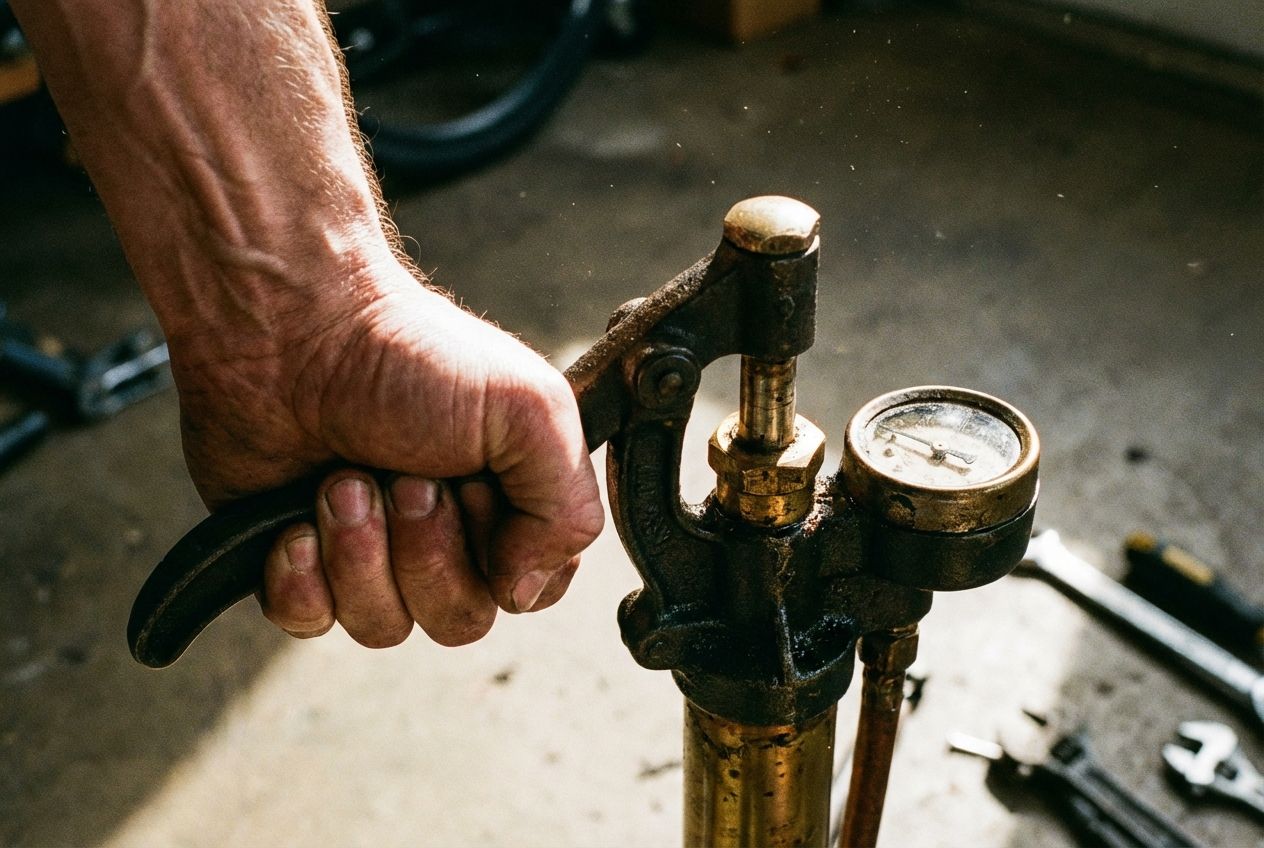
A close-up, dramatic photograph of a strong hand firmly gripping and pushing down the handle of a vintage, heavy-duty bicycle pump. The metal of the pump gleams under intense, directional light, conveying the physical effort and the build-up of pressure, composed for a 3:2 landscape frame.

Management & Tools

Deck Contents

22 Cards
Lesson#1
In this deck, we'll explore the behaviour of gases, building on the particle model of matter. You'll learn how the tiny, fast-moving particles in a gas create pressure, and how that pressure is affected by changes in temperature and volume. We'll also look at what happens when you do work on a gas, like when you use a bicycle pump.
Lesson#2
Imagine a box filled with gas. Inside, there are billions of particles, all moving randomly and at high speeds. These particles are constantly bumping into each other and, crucially, colliding with the inner walls of the box. Each collision exerts a tiny force on the wall.
Quiz#3
How do the particles of a gas exert a pressure on the walls of a container?

by colliding with the walls

Lesson#4
While the force from a single particle collision is incredibly small, there are countless collisions happening every second. The total effect of all these forces, spread over the area of the container's walls, is what we measure as gas pressure.
Quiz#5
In a gas, what is the overall effect of billions of particles colliding with the container walls over a certain area?

pressure

Lesson#6
Now, let's bring temperature into the picture. The temperature of a gas is a measure of the average kinetic energy of its particles. So, if you heat a gas, you are giving its particles more kinetic energy, which means they move faster.

Login to View Content

Create a free account or log in to see all 22 cards and start studying this deck.

Learn AQA GCSE Physics: Gas Pressure differently

Auracle is an audio-first learning platform built for busy people. Memorize anything without looking at a screen.

Hands-Free Learning

Listen, interact, and review cards entirely through audio. Perfect for commuting, walking, or at the gym.

Spaced Repetition

Auracle uses a scientific algorithm to schedule your reviews at the optimal time, ensuring you never forget what you learn.

Learn how it works

Ready to start the AQA GCSE Physics: Gas Pressure audio deck?