Tutorial

AQA GCSE Chemistry: Understand the Reactivity Series and Redox

Covers the reactivity series of metals, including their reactions with acid and water. Explains displacement reactions and the extraction of metals. Defines oxidation and reduction in terms of both oxygen and electrons (OILRIG).
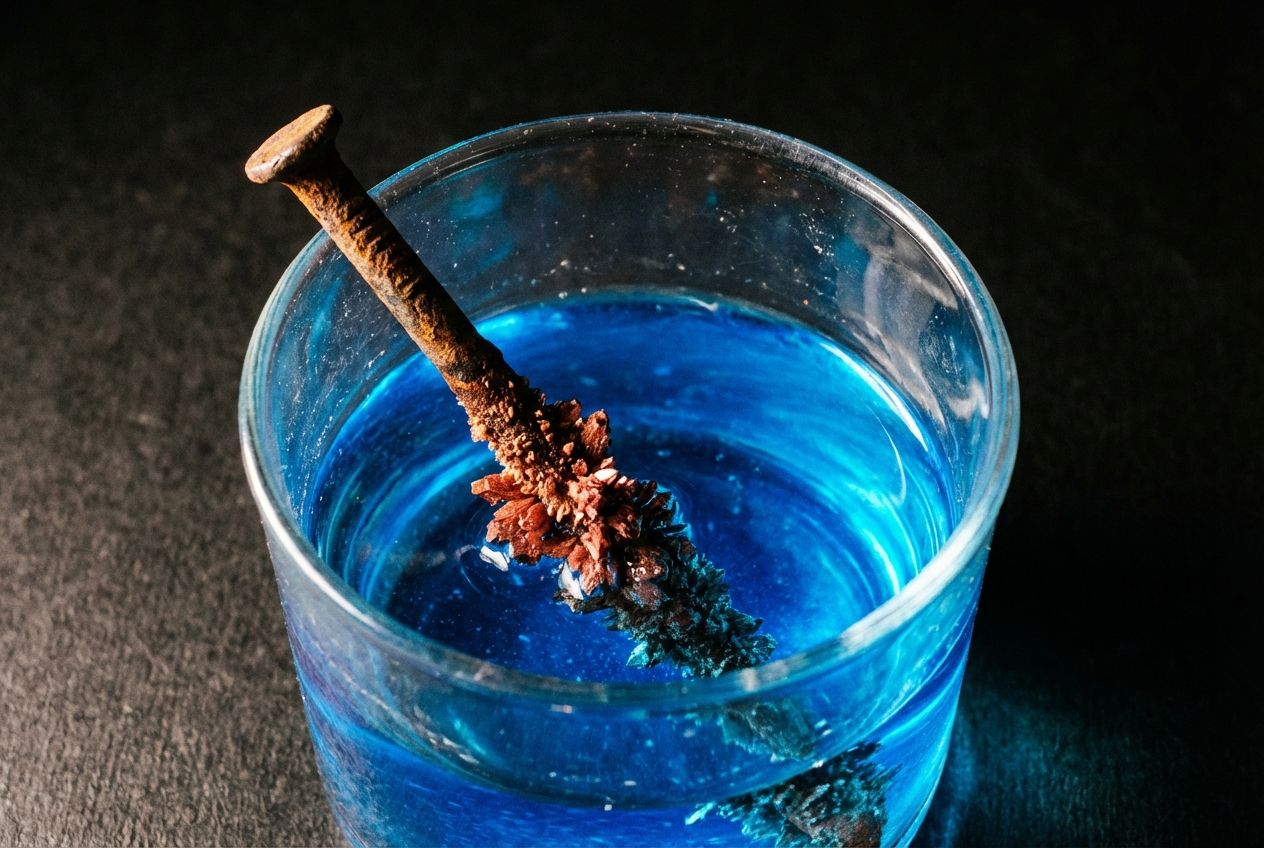
A dramatic, high-contrast close-up photograph of an old iron nail partially submerged in a vibrant blue copper sulfate solution in a clear glass beaker. Fresh, reddish-brown copper deposits are visibly forming on the submerged part of the nail, showcasing a chemical displacement reaction, composed for a 3:2 landscape frame. The scene is lit to emphasize the texture of the materials and the striking color transformation.

Management & Tools

Deck Contents

35 Cards
Lesson#1
In this deck, we'll explore the reactivity series of metals. You'll learn how to predict how metals will react with water and acids, and how they can displace each other from compounds. We'll also see how a metal's reactivity determines how it's extracted from the ground. Finally, we'll cover the important concepts of oxidation and reduction, both in terms of oxygen and electrons.
Lesson#2
Think of the reactivity of metals as a league table. The most reactive metals are at the top, and the least reactive are at the bottom. A metal's reactivity is all about how easily it loses electrons to form a positive ion. The more easily it loses electrons, the more reactive it is. The common order you need to know for GCSE is: Potassium, Sodium, Lithium, Calcium, Magnesium, Aluminium, Carbon, Zinc, Iron, Hydrogen, and then Copper, Silver, Gold.
Quiz#3
In chemistry, what does a metal's reactivity indicate about its tendency to form a positive ion?

how easily it loses electrons

Lesson#4
That's a long list to remember, so many people use a mnemonic. A popular one is: 'Please Send Lions, Cats, Monkeys And Cute Zebras Into Hot Countries, Signed Gordon'. The 'P' in 'Please' is for Potassium, 'S' in 'Send' is for Sodium, and so on. Notice that Carbon and Hydrogen are included in the series for comparison, even though they are not metals.
Quiz#5
Of the common metals in the reactivity series, which is the most reactive?

Potassium

Quiz#6
Of the common metals in the reactivity series, which is one of the least reactive, often found uncombined?

Gold

Login to View Content

Create a free account or log in to see all 35 cards and start studying this deck.

Learn AQA GCSE Chemistry: Understand the Reactivity Series and Redox differently

Auracle is an audio-first learning platform built for busy people. Memorize anything without looking at a screen.

Hands-Free Learning

Listen, interact, and review cards entirely through audio. Perfect for commuting, walking, or at the gym.

Spaced Repetition

Auracle uses a scientific algorithm to schedule your reviews at the optimal time, ensuring you never forget what you learn.

Learn how it works

Ready to start the AQA GCSE Chemistry: Understand the Reactivity Series and Redox audio deck?