Tutorial

AQA GCSE Chemistry: Required Practical - Titration

Learn the method for the required practical on titration. This deck covers the correct use of a pipette and burette, the role of indicators, how to obtain accurate and reliable results, and the calculations needed to determine the concentration of a solution.
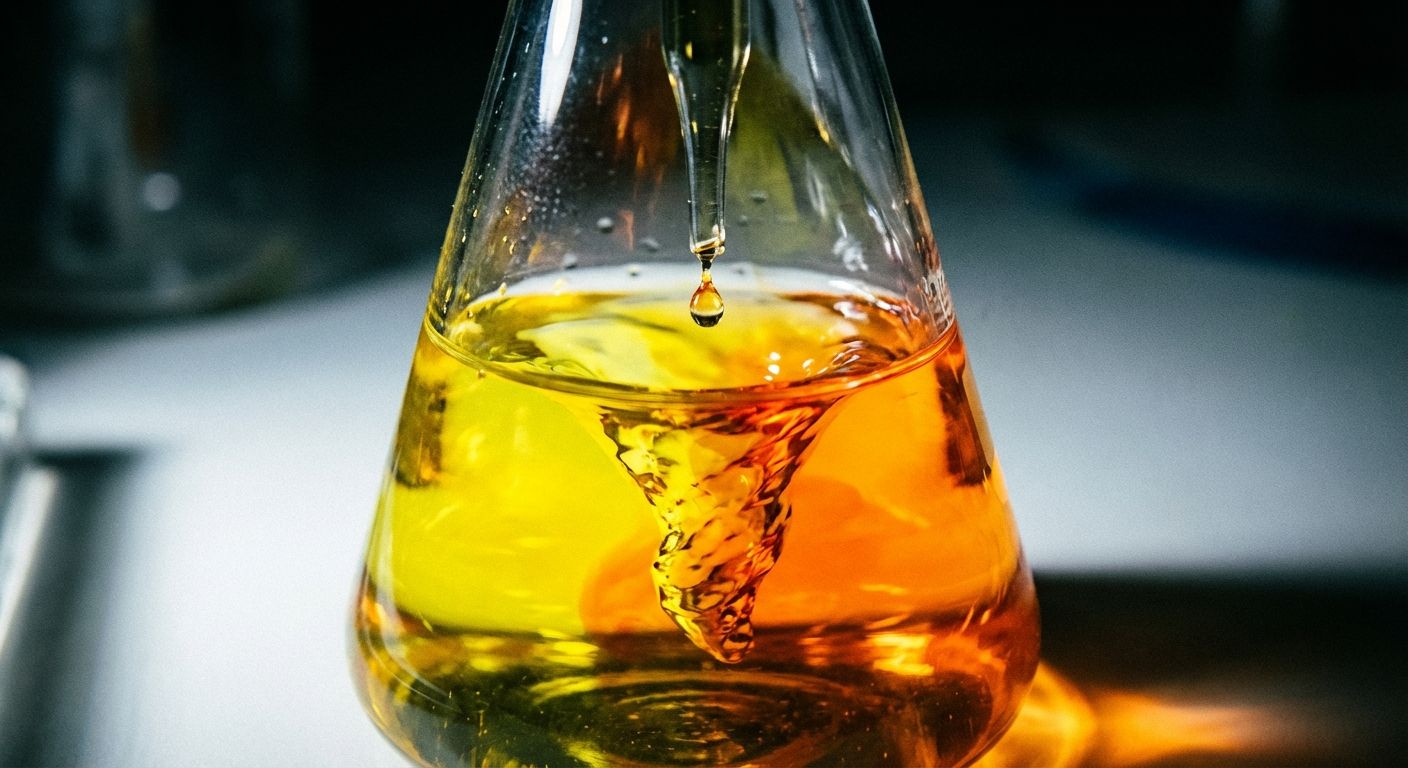
An extreme close-up, dramatic photograph captures a chemical titration in progress. A burette precisely drips liquid into a swirling conical flask, where a vibrant yellow solution is just transitioning to a striking orange, signaling the endpoint. The scene is illuminated with focused, scientific light, emphasizing the vivid color change and precision.

Management & Tools

Deck Contents

33 Cards
Lesson#1
Welcome to this deck on the required practical for titration. Titration is a very accurate technique used in chemistry to find out the exact volume of an acid needed to neutralise a specific volume of an alkali. This allows us to calculate the concentration of one of the solutions if we know the concentration of the other. We will go through the equipment, the step-by-step method, and how to get reliable results. For higher tier students, we will also cover the calculations involved.
Lesson#2
To carry out a titration accurately, we use specific pieces of glassware. A pipette, along with a pipette filler for safety, is used to measure out a very precise, fixed volume of the alkali. A burette, which is a long glass tube with a tap at the bottom, is used to add the acid. It lets us add the acid a small amount at a time and measure the exact volume we've used. Finally, the reaction itself takes place in a conical flask.
Quiz#3
In a titration, what piece of equipment is used to accurately measure a single, fixed volume of a solution, such as 25 centimetres cubed of alkali?

pipette

Quiz#4
In a titration, what is the name of the long glass tube with a tap, used to add a variable volume of solution accurately?

burette

Quiz#5
During a titration, into which piece of glassware is the alkali and indicator placed?

conical flask

Lesson#6
The first step is to measure the alkali. Using a pipette filler, you draw a precise volume of alkali, for example 25 centimetres cubed, into a pipette. It's crucial to read the volume with your eye level with the bottom of the meniscus, which is the curved surface of the liquid. You then transfer this alkali into a clean conical flask.

Login to View Content

Create a free account or log in to see all 33 cards and start studying this deck.

Learn AQA GCSE Chemistry: Required Practical - Titration differently

Auracle is an audio-first learning platform built for busy people. Memorize anything without looking at a screen.

Hands-Free Learning

Listen, interact, and review cards entirely through audio. Perfect for commuting, walking, or at the gym.

Spaced Repetition

Auracle uses a scientific algorithm to schedule your reviews at the optimal time, ensuring you never forget what you learn.

Learn how it works

Ready to start the AQA GCSE Chemistry: Required Practical - Titration audio deck?