Tutorial

Buddhist Places of Worship and Puja: AQA GCSE Religious Studies Buddhism

Covers Buddhist places of worship including temples, shrines, viharas and gompas; the key features and symbolic meanings of offerings at shrines; and the full practice of puja including chanting, mantra recitation and the use of malas.
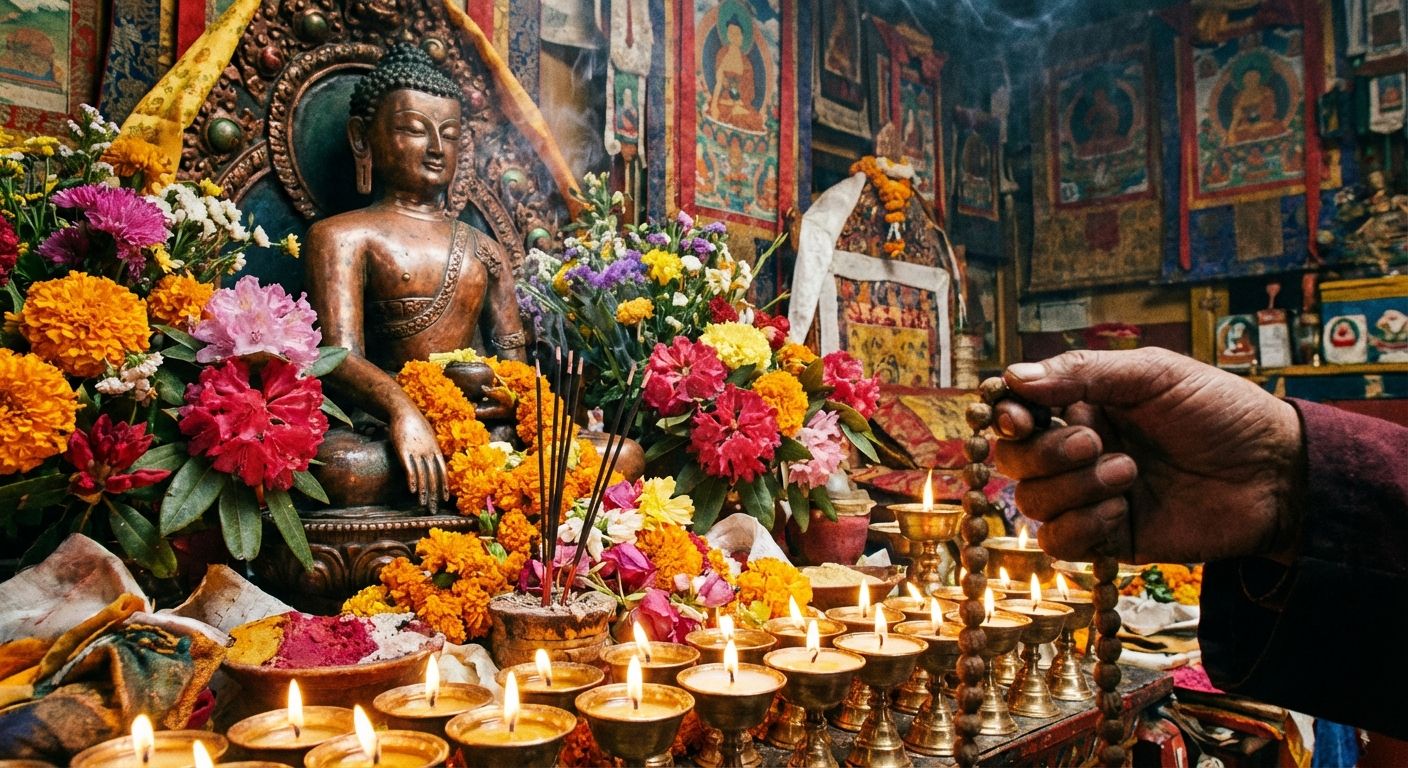
A dramatic close-up photograph of a vibrant Tibetan Buddhist shrine, featuring a serene Buddha rupa surrounded by fresh, colorful offerings of flowers, burning incense, and flickering butter lamps. In the foreground, a hand gently holds a string of mala beads, emphasizing the devotional practice.

Management & Tools

Deck Contents

41 Cards
Lesson#1
In this deck you will learn about the places where Buddhists worship and practise, and about puja, the devotional ritual at the heart of Buddhist practice. You will learn the names and features of four types of Buddhist place of worship, the symbolic meanings of offerings made at shrines, and how Buddhists use chanting, mantras and prayer beads in their devotional life. All of this is directly examinable on the AQA GCSE Religious Studies paper, so pay close attention to the specialist terms and their meanings.
Lesson#2
Buddhism does not have one single type of sacred building the way some religions do. Instead, Buddhists use several different kinds of place for worship, meditation and learning. The four main types you need to know for your exam are: temples, shrines, monasteries known as viharas, and meditation or learning halls known as gompas. Each has its own character and purpose, though they share many features in common. Let us look at each one in turn.
Lesson#3
A Buddhist temple is a place of communal worship open to both monks and lay Buddhists, meaning ordinary Buddhists who are not monks or nuns. Temples vary enormously in style across different Buddhist traditions and countries. A Thai temple looks very different from a Japanese one, but they share key features: an image or statue of the Buddha, space for offerings, and an area for meditation and chanting. Temples are places where the community gathers for festivals, ceremonies and teaching. In Britain, many Buddhist temples serve as community centres for the local Buddhist population, offering a space for practice and connection.
Quiz#4
In Buddhism, what term describes ordinary Buddhists who are not monks or nuns?

lay Buddhists

Lesson#5
A shrine is a sacred space containing a Buddha image and offerings. Shrines can be found inside temples, monasteries and meditation halls, but they can also be set up in the home. Home shrines are very important in Buddhist practice because they allow lay Buddhists to perform daily devotion without travelling to a temple. A typical shrine will have a Buddha rupa at its centre, surrounded by offerings such as flowers, incense and candles or lamps. The word rupa simply means form or image, so a Buddha rupa is a physical representation of the Buddha, usually a statue.
Quiz#6
What is the Buddhist term for a statue or image of the Buddha used in worship?

Buddha rupa

Login to View Content

Create a free account or log in to see all 41 cards and start studying this deck.

Learn Buddhist Places of Worship and Puja: AQA GCSE Religious Studies Buddhism differently

Auracle is an audio-first learning platform built for busy people. Memorize anything without looking at a screen.

Hands-Free Learning

Listen, interact, and review cards entirely through audio. Perfect for commuting, walking, or at the gym.

Spaced Repetition

Auracle uses a scientific algorithm to schedule your reviews at the optimal time, ensuring you never forget what you learn.

Learn how it works

Ready to start the Buddhist Places of Worship and Puja: AQA GCSE Religious Studies Buddhism audio deck?