Tutorial

Ancient Greek Philosophy: Plato's Just Soul and Aristotle's Flourishing Life

An exploration of Plato's tripartite soul and the idea that justice is inner harmony, followed by Aristotle's virtue ethics, the concept of Eudaimonia as human flourishing, and the Doctrine of the Mean as a practical guide to developing good character.
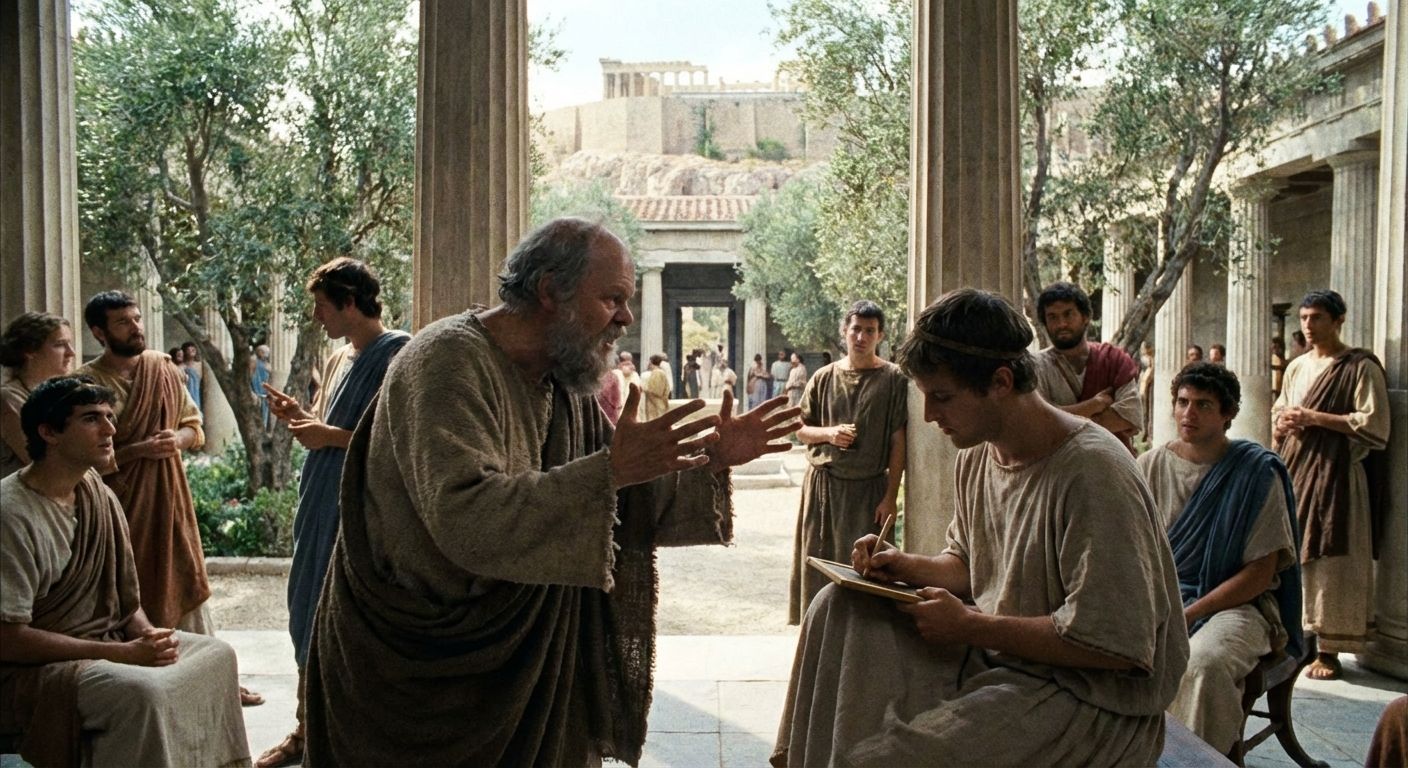
The image depicts a scene reminiscent of ancient Greece, staged in a courtyard setting with classical architecture.  A grey-bearded man, likely a philosopher or teacher, stands at the forefront, animatedly gesturing with his hands while speaking to his followers.  Students in tunics surround him, listening attentively. A young man seated on the right takes notes on a tablet.  

The colors are muted and earthy, with prevalent beiges, browns, and creams in the clothing and architecture. The courtyard is lush with greenery, and in the background, through an archway framed by columns, the Acropolis stands on a hill. The composition is layered, creating depth. The lighting suggests a sunny day, casting shadows within the courtyard. Overall the style has a vintage, possibly cinematic feel.

Management & Tools

Deck Contents

36 Cards
Lesson#1
Welcome to this deck on two of the greatest thinkers in the history of Western philosophy: Plato and Aristotle. These two men were teacher and student, and yet they disagreed about almost everything that mattered. Together, they set the agenda for philosophy in the Western world for the next two thousand years. In this deck, we will explore Plato's vision of the just soul — his radical claim that justice is not something that happens between people, but something that happens inside you. And then we will turn to Aristotle, who asked a deceptively simple question: what does it mean for a human being to truly flourish? His answer, built around the idea of Eudaimonia and the virtues, remains one of the most compelling accounts of the good life ever written. By the end, you will have two powerful frameworks for thinking about your own character and how you want to live.
Lesson#2
Let us begin with Plato. Born around 428 BC in Athens, Plato was a young man when he became a devoted follower of Socrates. He watched his mentor put on trial, condemned on charges of corrupting the youth and impiety, and forced to drink hemlock. Plato never recovered from this. The execution of the wisest man he knew, carried out by a democratic vote, left him with a lifelong suspicion of democracy and a burning conviction that the world would only go right when philosophers were in charge. He founded his famous school, the Academy, around 387 BC — the first institution of higher learning in the Western world. It lasted for over nine hundred years. Among its students was a young man from northern Greece named Aristotle, who would eventually surpass his teacher in influence, though never in Plato's own estimation.
Lesson#3
Plato's most famous work is a long dialogue called the Republic. On the surface, it is a book about justice — what justice is, and whether a just person is happier than an unjust one. But it is also a book about the soul, about politics, about education, and about the nature of reality. Plato's method throughout is the dialogue: his characters argue, challenge each other, and reason their way toward truth. The main character is always Socrates, though scholars believe the views expressed are largely Plato's own. The Republic opens with a challenge from a character named Thrasymachus, who argues that justice is simply whatever is in the interest of the stronger party. Might makes right. The whole rest of the book is Plato's attempt to prove him wrong.
Lesson#4
To answer the question of what justice is, Plato makes a bold move. He says: let us look at justice in the city first, because a city is bigger and easier to see clearly. Then we can look for the same pattern in the individual soul. This analogy between the city and the soul is one of the most creative moves in the history of philosophy. Plato argues that a just city has three classes of people: the rulers, who govern with wisdom; the soldiers, who defend the city with courage; and the producers — farmers, craftspeople, merchants — who keep the city fed and functioning. Justice in the city, Plato says, is when each of these three classes does its own job and does not interfere with the others. The rulers rule. The soldiers fight. The producers produce. Each in its proper place.
Lesson#5
Now Plato applies the same structure to the human soul. He argues that the soul has three parts, mirroring the three classes of the city. The first part is reason — the part that thinks, calculates, and seeks truth. The second part is spirit, or what he sometimes calls thumos — the part that feels pride, honour, anger, and the drive to compete and excel. The third part is appetite — the part that desires food, drink, sex, money, and all the pleasures of the body. Plato believed these three parts are genuinely distinct and can come into conflict. Think of a time you knew you should not eat something but wanted it desperately anyway. That is reason and appetite in conflict. Or a time when you felt ashamed of yourself for doing something you knew was beneath you — that is spirit reproaching appetite. The soul is not a unity. It is a battleground.
Quiz#6
According to Plato, how many parts does the soul have?

three

Login to View Content

Create a free account or log in to see all 36 cards and start studying this deck.

Learn Ancient Greek Philosophy: Plato's Just Soul and Aristotle's Flourishing Life differently

Auracle is an audio-first learning platform built for busy people. Memorize anything without looking at a screen.

Hands-Free Learning

Listen, interact, and review cards entirely through audio. Perfect for commuting, walking, or at the gym.

Spaced Repetition

Auracle uses a scientific algorithm to schedule your reviews at the optimal time, ensuring you never forget what you learn.

Learn how it works

Ready to start the Ancient Greek Philosophy: Plato's Just Soul and Aristotle's Flourishing Life audio deck?