Tutorial

AQA GCSE Geography: Paper 1 (Optional) - Physical Landscapes: Rivers

This is an optional topic. Check with your teacher before studying. Learn about river processes of erosion, transportation, and deposition, and the landforms they create in the upper, middle, and lower course of a river.
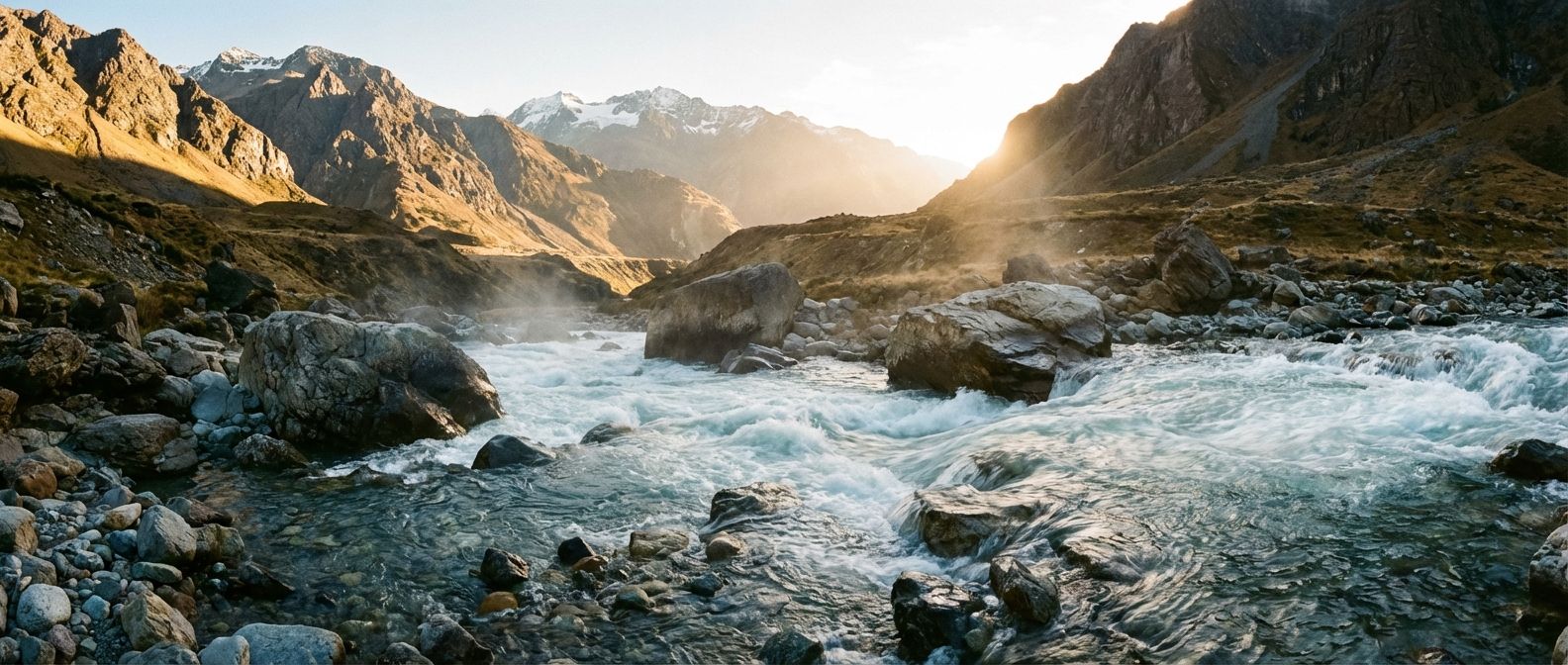
A dramatic wide-angle photograph of a powerful, fast-flowing river carving its way through a rugged, rocky V-shaped valley in a mountainous landscape. The clear water churns around large boulders, with smaller pebbles visible on the riverbed, hinting at the force of erosion and transportation. Golden hour sunlight illuminates the scene, casting long shadows.

Management & Tools

Deck Contents

46 Cards
Lesson#1
Welcome to this deck on river landscapes in the UK. This is an optional topic for Paper 1 of your AQA GCSE Geography exam, so please check with your teacher that you are studying it. We will explore how rivers shape the land through erosion, transportation, and deposition, and look at the distinctive landforms they create from their source in the mountains to their mouth at the sea.
Lesson#2
The journey of a river from its source to its mouth can be shown on a diagram called a long profile. It's essentially a line graph showing the change in the river's gradient, or steepness, over its entire course. Typically, the long profile is steep in the upper course, has a gentler gradient in the middle course, and is almost flat in the lower course as it approaches the sea.
Quiz#3
In geography, what diagram shows the change in a river's gradient from source to mouth?

long profile

Lesson#4
As well as a long profile, we can look at a river's cross-profile, which is a view of the valley from one side to the other. The shape of this cross-profile changes dramatically along the river's course. In the upper course, where the river is high up and has a lot of energy for vertical erosion, it carves out a steep-sided, narrow valley.
Quiz#5
What is the typical shape of a river valley's cross-profile in the upper course?

V-shaped

Lesson#6
As the river flows into its middle and lower course, it has less vertical erosive power and more energy for lateral, or sideways, erosion. This, combined with deposition, creates a much wider and flatter valley floor. The river channel itself also becomes wider and deeper.

Login to View Content

Create a free account or log in to see all 46 cards and start studying this deck.

Learn AQA GCSE Geography: Paper 1 (Optional) - Physical Landscapes: Rivers differently

Auracle is an audio-first learning platform built for busy people. Memorize anything without looking at a screen.

Hands-Free Learning

Listen, interact, and review cards entirely through audio. Perfect for commuting, walking, or at the gym.

Spaced Repetition

Auracle uses a scientific algorithm to schedule your reviews at the optimal time, ensuring you never forget what you learn.

Learn how it works

Ready to start the AQA GCSE Geography: Paper 1 (Optional) - Physical Landscapes: Rivers audio deck?