Tutorial

AQA GCSE Biology: Required Practical - Rate of Decay

This deck covers the required practical investigating the effect of temperature on the rate of decay of fresh milk. It explains the role of lipase, the use of a pH indicator, the variables, method, and how to interpret the results.
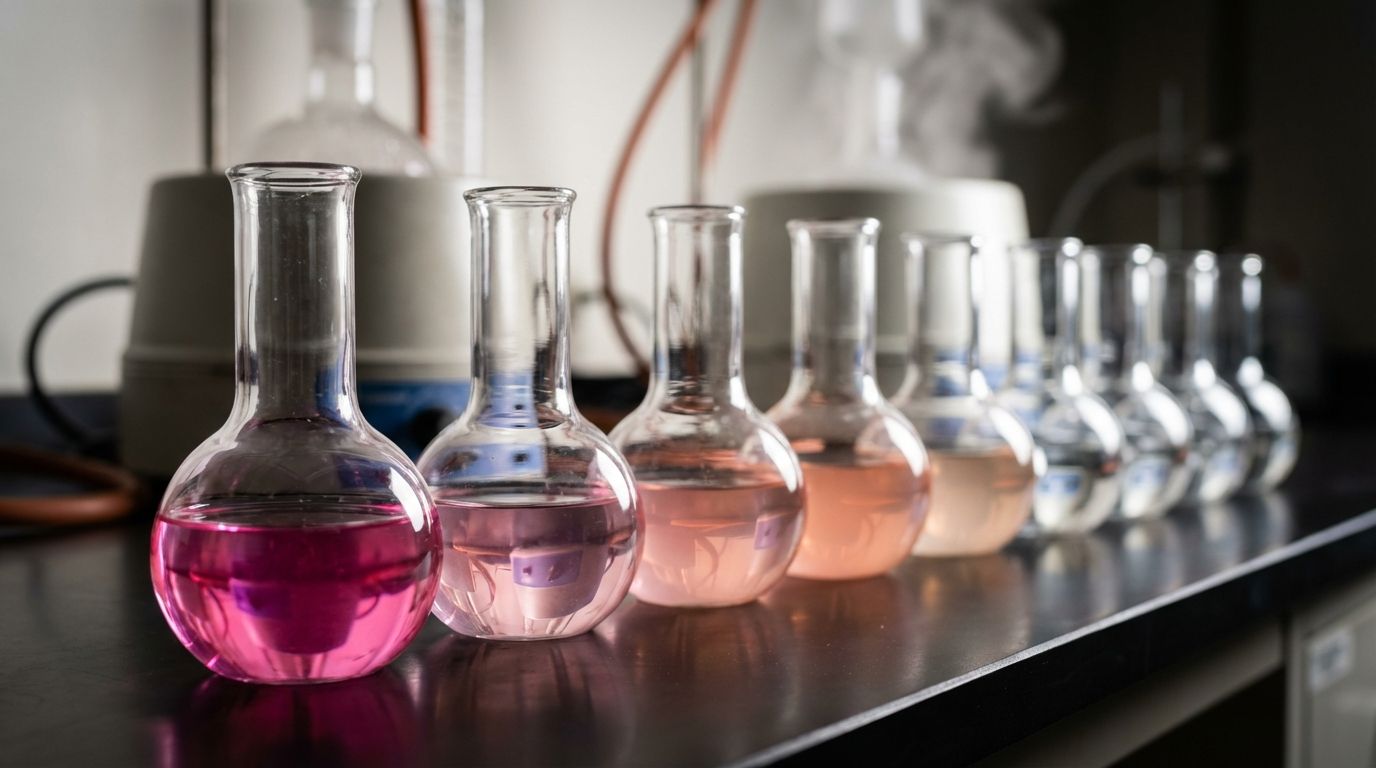
A dramatic, wide-angle close-up photograph of a row of elegant glass beakers or small flasks, arranged horizontally on a sleek, dark laboratory bench. Each beaker contains a liquid, with the first being a vibrant, clear pink, and subsequent beakers showing a gradual fading gradient of pink to completely colourless, visually representing a chemical reaction over time or varying temperatures. Soft, focused light illuminates the liquids, creating reflections, with a subtle hint of scientific equipment or diffuse steam in the background to suggest an experimental setting.

Management & Tools

Deck Contents

26 Cards
Lesson#1
In this deck, you will learn about the required practical for AQA GCSE Biology that investigates the effect of temperature on the rate of decay. We will explore how to use milk, the enzyme lipase, and a pH indicator to measure how quickly decay happens at different temperatures. You will learn about the variables you need to control, the method you should follow, and how to interpret the results.
Quiz#2
What is the aim of the required practical involving milk and the enzyme lipase?

To investigate the effect of temperature on the rate of decay

Lesson#3
Decay is the breakdown of complex materials into simpler ones by microorganisms or enzymes. In this practical, we are looking at the decay of milk. Milk contains fat, which is a type of lipid. We use an enzyme called lipase to speed up the breakdown of this fat. When lipase breaks down the fat, it produces fatty acids. As their name suggests, these fatty acids are acidic, which means they lower the pH of the solution.
Quiz#4
What type of enzyme is used to break down the fat in milk?

Lipase

Quiz#5
When lipase breaks down fats in milk, what acidic substances are produced?

Fatty acids

Lesson#6
To see this pH change happen, we need a pH indicator. A common choice is phenolphthalein. To start the experiment, we make the milk solution slightly alkaline, for example by adding sodium carbonate. In this alkaline solution, phenolphthalein is a bright pink colour. As the lipase breaks down the fat and produces fatty acids, the solution becomes acidic. This causes the phenolphthalein to lose its colour and become colourless. The time it takes for this to happen is our measurement of the rate of decay.

Login to View Content

Create a free account or log in to see all 26 cards and start studying this deck.

Learn AQA GCSE Biology: Required Practical - Rate of Decay differently

Auracle is an audio-first learning platform built for busy people. Memorize anything without looking at a screen.

Hands-Free Learning

Listen, interact, and review cards entirely through audio. Perfect for commuting, walking, or at the gym.

Spaced Repetition

Auracle uses a scientific algorithm to schedule your reviews at the optimal time, ensuring you never forget what you learn.

Learn how it works

Ready to start the AQA GCSE Biology: Required Practical - Rate of Decay audio deck?