Tutorial

The Art of Living: The Good Life in Judaism, Christianity, and Islam

A comparative exploration of the ethical frameworks for a good life within the three Abrahamic faiths. Covers Tikkun Olam in Judaism, Agape love and the Beatitudes in Christianity, and the Five Pillars and Ihsan in Islam, highlighting both shared values and unique contributions.
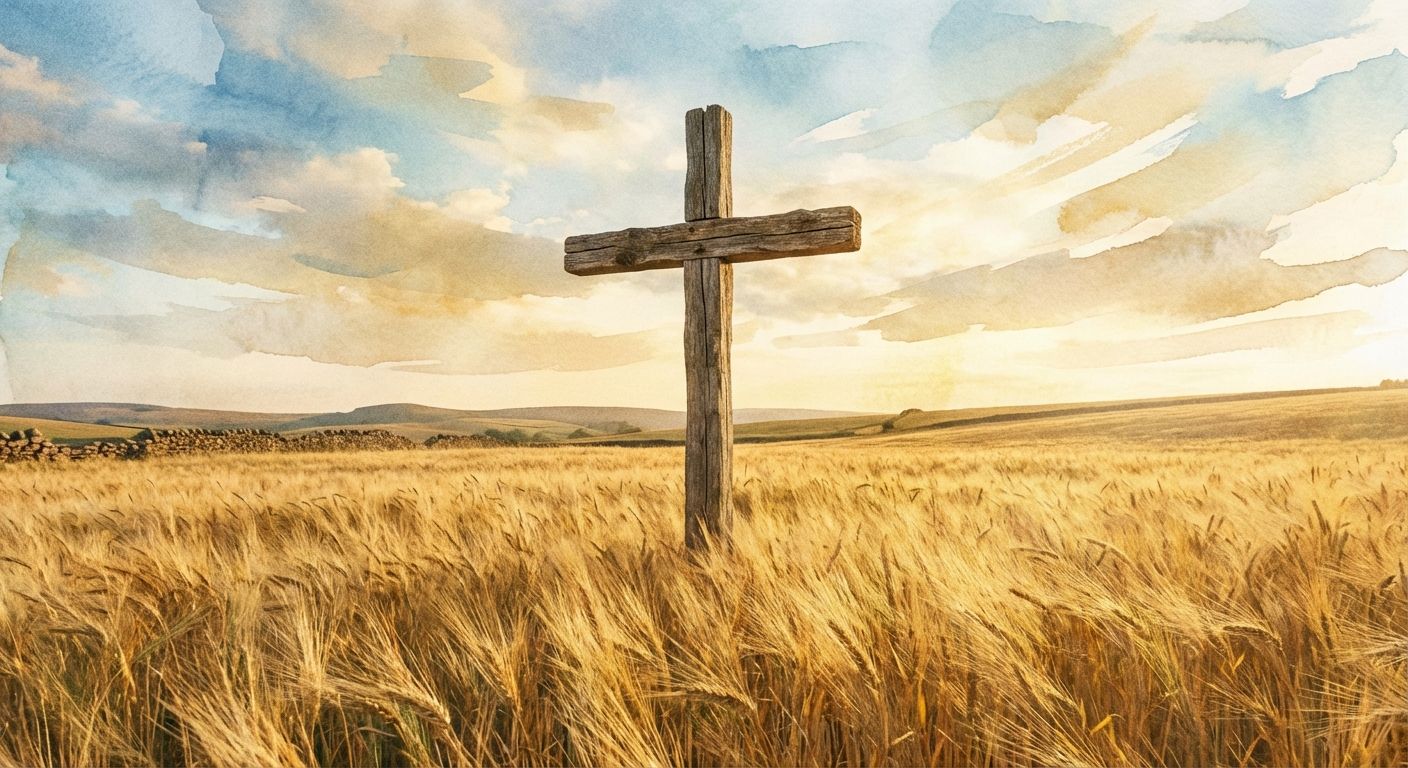
This is a watercolor-style landscape painting. The subject is a simple wooden cross standing tall in a golden wheat field. The cross is centered in the frame. The field extends into the distance, meeting low rolling hills on the horizon. The sky is a soft gradient of blues and golds, mimicking the colors of dawn or dusk. The painting has a gentle, diffused light quality. The brushstrokes are loose and suggest movement in the wheat. The overall tone is peaceful and serene.

Management & Tools

Deck Contents

30 Cards
Lesson#1
Three of the world's great religions share a common ancestor. Judaism, Christianity, and Islam all trace their roots to Abraham, the ancient patriarch who, according to their shared scriptures, entered into a covenant with God. They are called the Abrahamic faiths. And while they have often been in conflict throughout history, they share a remarkable amount of common ground when it comes to the most fundamental question of this course: how should a human being live? In this deck, we are going to explore what each tradition has to say about the good life — not just as a matter of private piety, but as a comprehensive ethical framework for how to treat others, how to relate to God, and how to build a just and flourishing world.
Lesson#2
Let us begin with Judaism, the oldest of the three traditions. Judaism is sometimes misunderstood as simply a religion of rules — a long list of commandments to follow. And it is true that Jewish law, known as Halakha, is extraordinarily detailed, governing everything from what you eat to how you do business. But to see Judaism purely as a legal system is to miss its beating heart. At the centre of Jewish ethics is a concept called Tikkun Olam. In Hebrew, Tikkun Olam means repair of the world. The idea is that the world as it exists is broken — full of suffering, injustice, and incompleteness — and that human beings have a sacred responsibility to repair it. This is not a passive hope that God will one day fix things. It is an active calling. Every act of justice, every act of kindness, every effort to reduce suffering is a contribution to the great project of mending the world.
Quiz#3
What Hebrew phrase, meaning repair of the world, describes the Jewish ethical duty to work toward justice and healing in the world?

Tikkun Olam

Lesson#4
The concept of Tikkun Olam has deep roots in the Kabbalah, the Jewish mystical tradition, where it referred to a cosmic process of gathering the scattered sparks of divine light that had been fragmented at the moment of creation. Over time, the phrase took on a broader ethical meaning, and today it is one of the most widely cited concepts in modern Jewish thought. It is the reason why Jewish communities have historically been so active in social justice movements — fighting for workers' rights, civil rights, and refugee protection. To repair the world is not optional. It is what God asks of every human being.
Lesson#5
Tikkun Olam is closely connected to another foundational idea in Judaism: the covenant. According to the Hebrew Bible, God entered into a special agreement with the Jewish people — a covenant, or brit in Hebrew. In exchange for following God's commandments, God would be their God and they would be his people. But this covenant is not merely a transaction. It carries moral weight. The commandments are not arbitrary rules. They are a blueprint for a just society. The Torah commands care for the poor, fair treatment of workers, hospitality to strangers, and protection of the vulnerable. The good life, in Judaism, is not just about personal virtue. It is about building a community — and ultimately a world — that reflects the justice and compassion of God.
Quiz#6
What is the Hebrew term for the sacred agreement between God and the Jewish people?

brit

Login to View Content

Create a free account or log in to see all 30 cards and start studying this deck.

Learn The Art of Living: The Good Life in Judaism, Christianity, and Islam differently

Auracle is an audio-first learning platform built for busy people. Memorize anything without looking at a screen.

Hands-Free Learning

Listen, interact, and review cards entirely through audio. Perfect for commuting, walking, or at the gym.

Spaced Repetition

Auracle uses a scientific algorithm to schedule your reviews at the optimal time, ensuring you never forget what you learn.

Learn how it works

Ready to start the The Art of Living: The Good Life in Judaism, Christianity, and Islam audio deck?