Tutorial

GCSE Maths: Frequency and Two-Way Tables

This deck teaches you how to organise raw data. You will learn to construct and interpret tally charts, frequency tables, and two-way tables, which are fundamental tools for statistical analysis in GCSE Maths.
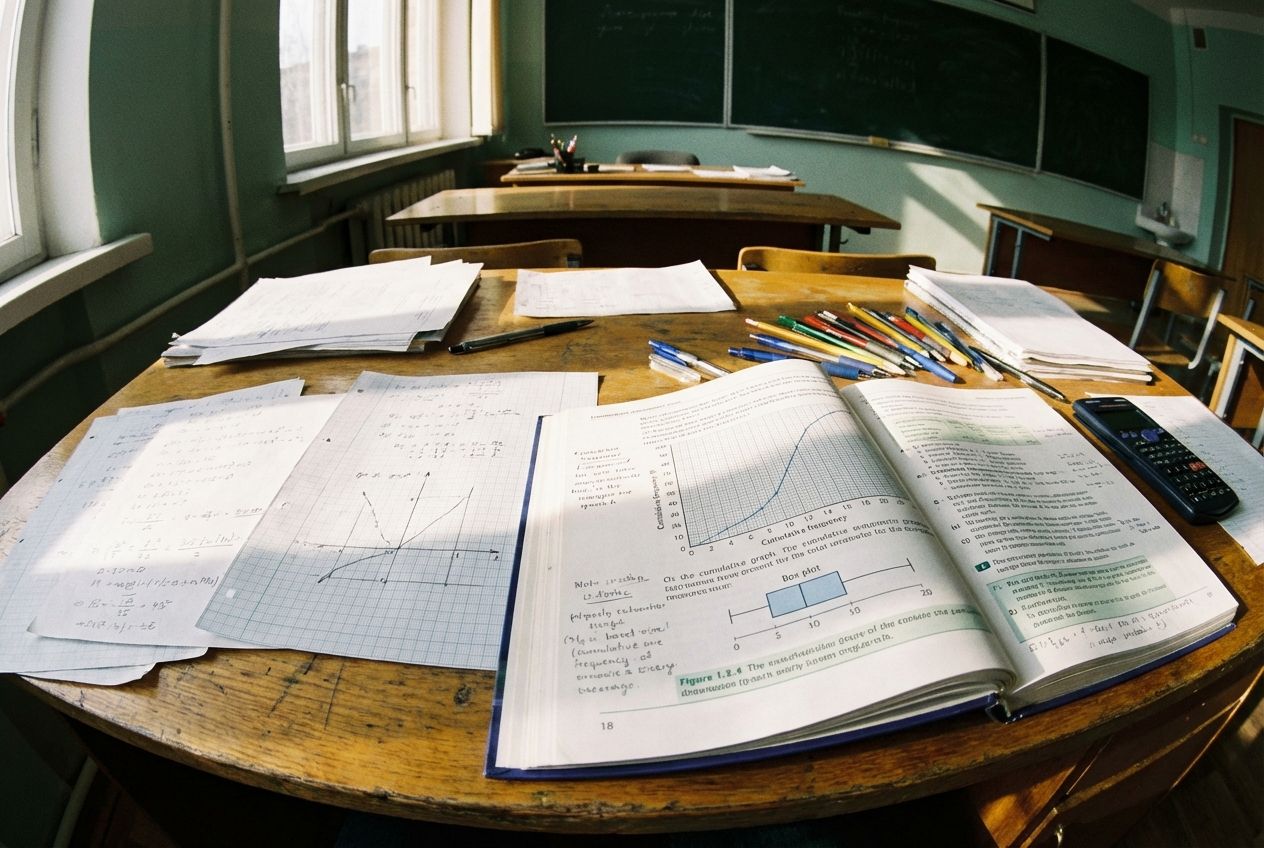
A wide-angle photograph of a classroom desk covered in handwritten notes and graphing paper, with a textbook open to a page displaying a cumulative frequency graph and a box plot diagram. Sunlight streams through a nearby window, illuminating the intricate details of the graphs and the textures of the paper and writing utensils.

Management & Tools

Deck Contents

21 Cards
Lesson#1
In this deck, you'll learn how to organise raw data to make it easier to understand. We'll cover tally charts, frequency tables, and two-way tables, which are essential skills for handling statistics in GCSE Maths.
Lesson#2
When you first collect data, like the results of a survey, it's often just a long, messy list. This is called raw data. To make sense of it, our first step is often to create a tally chart to count how many times each value appears.
Quiz#3
What is a tally chart primarily used for?

counting data

Lesson#4
To make a tally, you draw a vertical line for each item you count. When you get to the fifth item in a group, you draw a diagonal line across the first four. This creates a 'gate' shape, making it easy to count in fives.
Quiz#5
In a tally chart, what number does a 'gate' shape with a line through four marks represent?

five

Lesson#6
After you've finished tallying, the next step is to create a frequency table. 'Frequency' is just a mathematical word that means 'how many' or 'how often' something occurs. The frequency table neatly summarises the counts from your tally chart.

Login to View Content

Create a free account or log in to see all 21 cards and start studying this deck.

Learn GCSE Maths: Frequency and Two-Way Tables differently

Auracle is an audio-first learning platform built for busy people. Memorize anything without looking at a screen.

Hands-Free Learning

Listen, interact, and review cards entirely through audio. Perfect for commuting, walking, or at the gym.

Spaced Repetition

Auracle uses a scientific algorithm to schedule your reviews at the optimal time, ensuring you never forget what you learn.

Learn how it works

Ready to start the GCSE Maths: Frequency and Two-Way Tables audio deck?