GCSE Mathematics: Lower Tier
GCSE Maths, broken down so it actually makes sense. This covers the entire Lower Tier syllabus, aiming squarely for a solid Grade 4 or 5.
GCSE Mathematics: Lower Tier
GCSE Maths, broken down so it actually makes sense. This covers the entire Lower Tier syllabus, aiming squarely for a solid Grade 4 or 5.
Decks in this Course
47 items
GCSE Maths: Place Value and Ordering Numbers
This deck covers the fundamentals of place value for integers and decimals. You'll learn to identify the value of any digit, order positive and negative numbers, and use the inequality symbols correctly.

GCSE Maths: The Order of Operations (BIDMAS)
Learn the conventional order for performing mathematical operations, commonly known as BIDMAS or BODMAS, to ensure calculations are performed correctly.
GCSE Maths: Calculating with Negative Numbers
Master the four operations (add, subtract, multiply, divide) with negative integers, both with and without a calculator.
GCSE Maths: Factors, Multiples and Primes
Learn to identify factors, multiples, and prime numbers. This deck also covers how to express a number as a product of its prime factors, and how to find the Highest Common Factor (HCF) and Lowest Common Multiple (LCM).
GCSE Maths: Powers and Roots
Learn about square numbers, cube numbers, and their corresponding roots. Understand the notation for powers (indices) and calculate with them.
GCSE Maths: Rounding, Estimating and Bounds
Learn to round numbers to a given number of decimal places or significant figures. Use rounding to estimate the answer to a calculation and understand the concept of error intervals (upper and lower bounds).

GCSE Maths: Understanding and Comparing Fractions
Develop a solid understanding of what fractions represent. Learn to find equivalent fractions, simplify fractions to their lowest terms, and compare their sizes.
GCSE Maths: Calculating with Fractions
Learn the methods for adding, subtracting, multiplying, and dividing fractions and mixed numbers.

GCSE Maths: Fractions, Decimals and Percentages
Master the essential skill of converting between fractions, decimals, and percentages.
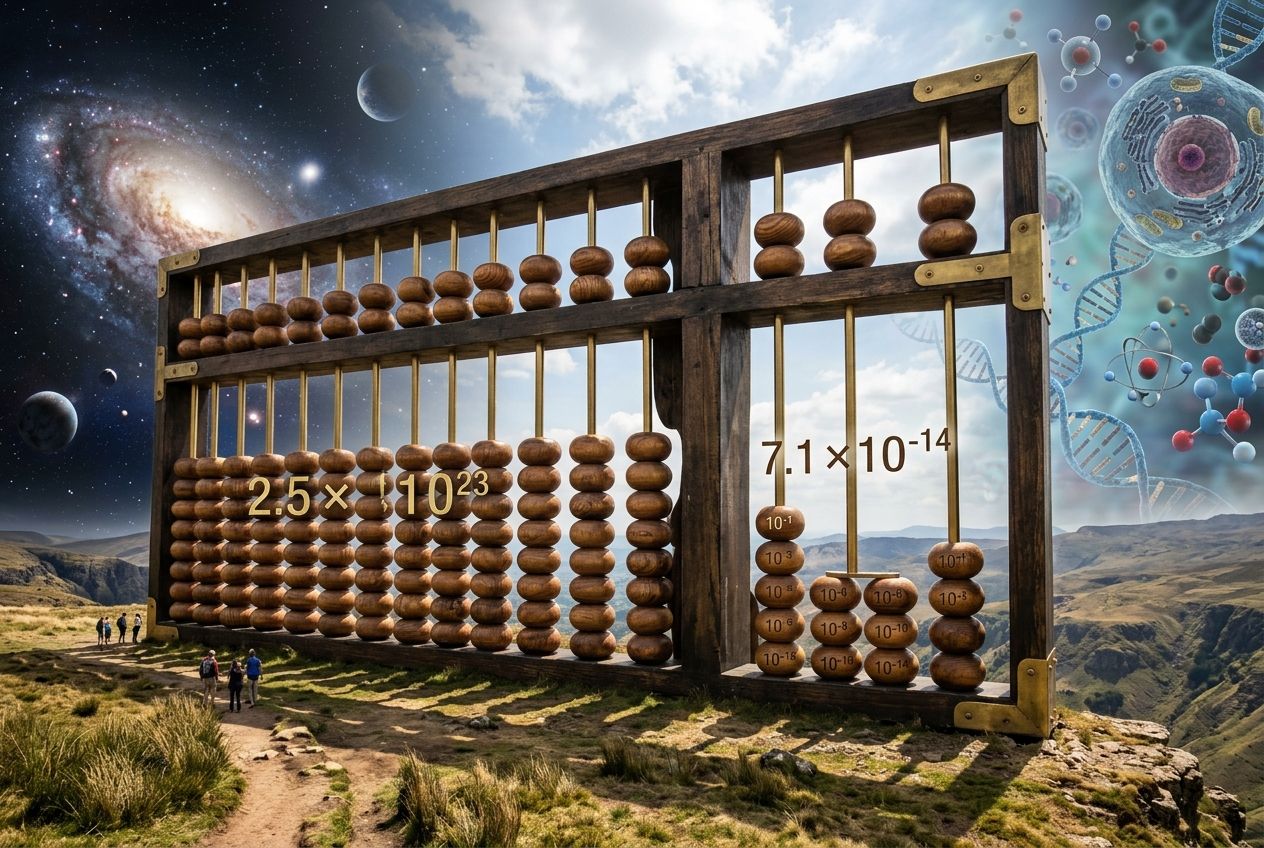
GCSE Maths: Introduction to Standard Form
Learn to read, write, and compare very large and very small numbers using standard form (scientific notation).

GCSE Maths: Introduction to Algebra
This deck introduces the fundamental concepts of algebra for GCSE Maths. You will learn what letters represent, the difference between terms, expressions, and equations, and the essential skill of simplifying expressions by collecting like terms and through multiplication.

GCSE Maths: Substitution into Formulae
Learn how to substitute numerical values into algebraic expressions and formulae to find their value.
GCSE Maths: Expanding and Factorising Single Brackets
Learn the inverse processes of expanding a single bracket and factorising an expression into a single bracket.

GCSE Maths: Solving Basic Linear Equations
Learn to solve one-step and two-step linear equations by using inverse operations to find the value of the unknown. This deck covers the fundamental principles of balancing equations and checking your solutions.
GCSE Maths: Solving Equations with Unknowns on Both Sides
Extend your equation-solving skills to linear equations that have the unknown variable on both sides of the equals sign, including those with brackets and word problems.
GCSE Maths: Coordinates and Linear Graphs
Learn to use coordinates in all four quadrants. Understand and plot the graphs of linear functions, and interpret the equation y = mx + c to find the gradient and y-intercept.

GCSE Maths: Linear Sequences and the Nth Term
Learn to recognise linear sequences, also known as arithmetic progressions. You'll find out how to continue them, describe their rules, and derive the all-important formula for the nth term.
GCSE Maths: Interpreting Real-Life Graphs
Learn to interpret and use real-life graphs, such as conversion graphs and distance-time graphs, to find information and solve problems.

GCSE Maths: Understanding and Using Ratios
Learn to use ratio notation, simplify ratios to their simplest form, and share an amount in a given ratio.

GCSE Maths: Direct Proportion and Recipes
Learn the concept of direct proportion and how to solve problems using two key methods: the unitary method and the scaling factor method. This deck focuses on a common real-world application: scaling recipes up or down to serve a different number of people.

GCSE Maths: Percentages of Amounts
Learn how to calculate percentages of quantities, both with and without a calculator. This deck covers finding percentages using building blocks like 10% and 1%, using decimal multipliers with a calculator, and how to express one quantity as a percentage of another.

GCSE Maths: Percentage Change and Simple Interest
Learn to calculate percentage increases and decreases, and to find the new amount after a percentage change. Understand and calculate simple interest.

GCSE Maths: Speed, Density and Other Compound Measures
Learn to use the formulae connecting speed, distance and time, as well as density, mass and volume, and solve related problems.

GCSE Maths: Units of Measure and Conversions
Learn the standard metric units for length, mass, and capacity. Master converting between related metric units and units of time.
GCSE Maths: Perimeter and Area of 2D Shapes
Learn to calculate the perimeter of any polygon and the area of common 2D shapes including rectangles, triangles, parallelograms, and trapeziums.

GCSE Maths: Circumference and Area of a Circle
Learn the terminology of circles (radius, diameter, circumference) and the formulae to calculate the circumference and area of a circle, as well as for semicircles and quarter circles.
GCSE Maths: Volume and Surface Area of 3D Shapes
Learn to calculate the volume and surface area of cuboids, prisms, and cylinders.

GCSE Maths: Plans and Elevations
Learn the definitions of plan, front elevation, and side elevation, and understand how these 2D drawings are used to represent a 3D solid.
GCSE Maths: Basic Angle Facts
Learn the fundamental rules for angles: angles on a straight line, angles around a point, and vertically opposite angles.

GCSE Maths: Angles in Parallel Lines
Learn to identify and use the properties of alternate, corresponding, and co-interior angles in parallel lines.

GCSE Maths: Angles in Polygons
Learn the properties of angles in triangles and quadrilaterals, and how to calculate interior and exterior angles of any regular polygon.
GCSE Maths: Pythagoras' Theorem
Learn Pythagoras' Theorem and how to use it to find the length of a missing side in a right-angled triangle.

GCSE Maths: Transformations - Reflection, Rotation, Translation
Learn to perform and describe three geometric transformations: reflection, rotation, and translation. This deck covers the essential rules and vocabulary for GCSE Maths.

GCSE Maths: Transformations - Enlargement
Learn to perform and describe enlargements of 2D shapes from a centre of enlargement by a positive integer scale factor.

GCSE Maths: Bearings
Learn the three rules for measuring and interpreting bearings, and how to calculate a return bearing. Bearings are used in navigation to describe direction.

GCSE Maths: Introduction to Probability
Learn the fundamental concepts of probability, including the language used to describe likelihood, the probability scale from 0 to 1, and how to calculate the probability of a single event.
GCSE Maths: Relative Frequency and Expected Outcomes
Learn to calculate relative frequency from experimental data and use it to find the expected number of outcomes in a series of trials.
GCSE Maths: Listing Outcomes and Sample Spaces
Learn to list all possible outcomes for one or more events in a systematic way, using lists, tables, and sample space diagrams.

GCSE Maths: Basic Probability Trees
Learn to use tree diagrams to represent the outcomes of two or more independent events and to calculate their probabilities.

GCSE Maths: Basic Venn Diagrams
Learn to organise data into a Venn diagram and use it to answer questions about the data, including basic probability.
GCSE Maths: Data Types and Collection
Learn about different types of data (qualitative, quantitative, discrete, continuous) and methods for collecting it, including primary and secondary sources, and the design of data collection sheets.
GCSE Maths: Frequency and Two-Way Tables
This deck teaches you how to organise raw data. You will learn to construct and interpret tally charts, frequency tables, and two-way tables, which are fundamental tools for statistical analysis in GCSE Maths.
GCSE Maths: Bar Charts and Pictograms
Learn to interpret and understand the key features of pictograms, bar charts, and line graphs. This deck covers how to read data from these diagrams, including understanding keys, axes, and trends, and explains the type of data each is used for.

GCSE Maths: Pie Charts
Learn how to construct a pie chart from a frequency table and how to interpret information from a given pie chart.
GCSE Maths: Scatter Graphs and Correlation
Learn to draw and interpret scatter graphs to see if there is a relationship (correlation) between two variables, and how to use a line of best fit to make estimates.

GCSE Maths: Averages and Range from a List
Learn to calculate the three main averages (mean, median, mode) and the range for a set of discrete data.

GCSE Maths: Averages from Frequency Tables
Master the techniques for finding key statistical averages—mode, median, and mean—from both discrete and grouped frequency tables. This deck breaks down the methods step-by-step, focusing on the concepts behind the calculations.
Learn GCSE Mathematics: Lower Tier differently
Auracle is an audio-first learning platform built for busy people. Memorize anything without looking at a screen.
Hands-Free Learning
Listen, interact, and review cards entirely through audio. Perfect for commuting, walking, or at the gym.
Spaced Repetition
Auracle uses a scientific algorithm to schedule your reviews at the optimal time, ensuring you never forget what you learn.
Learn how it works