Tutorial

AQA GCSE Physics: Work, Energy, and Elasticity

Explores the relationship between forces, energy transfer, and deformation. Covers work done, the link between work done and energy, Hooke's Law for springs, the limit of proportionality, and the difference between elastic and inelastic deformation.
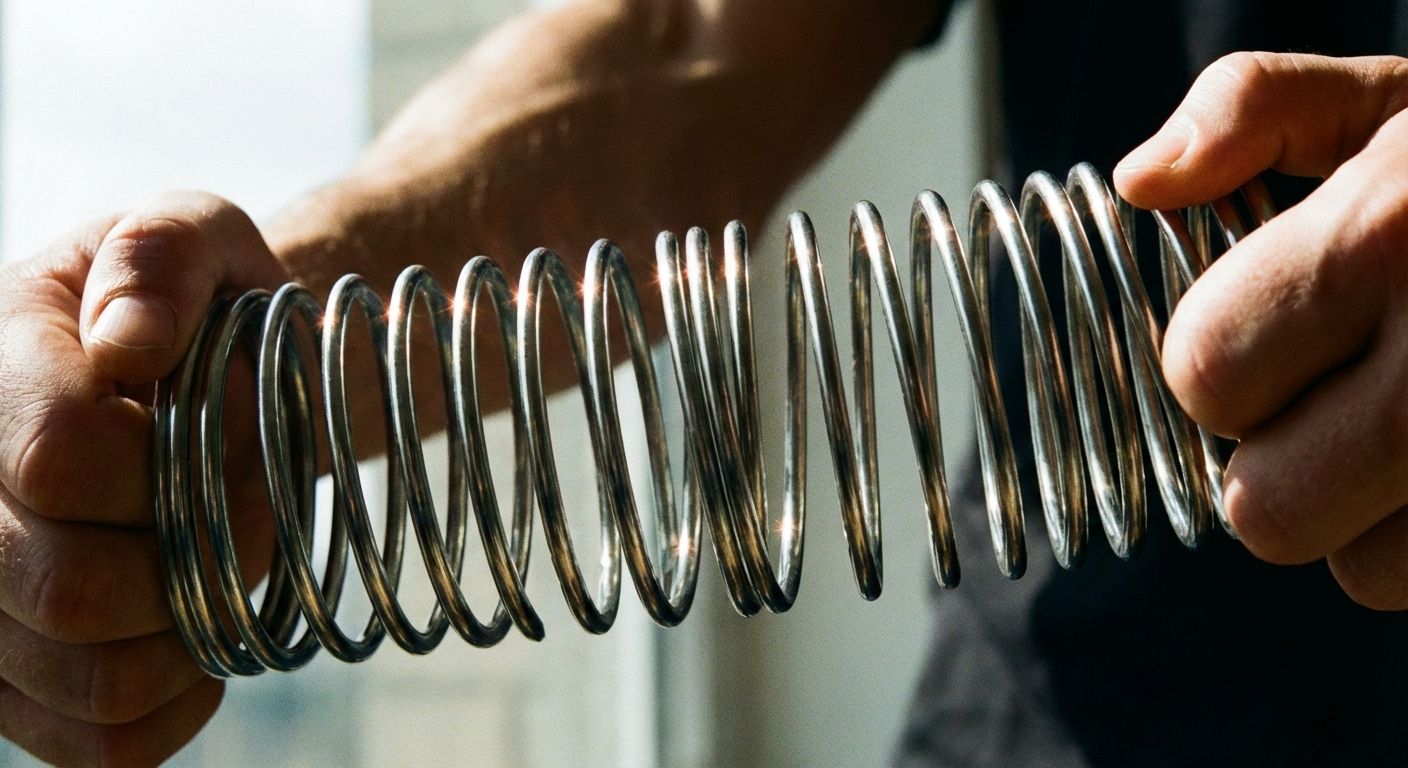
A close-up of a coiled spring being stretched, with light glinting off the metal and highlighting the tension.

Management & Tools

Deck Contents

20 Cards
Lesson#1
In this deck, we'll explore what happens when forces cause movement and change the shape of objects. You'll learn about the concept of 'work done' in physics and its direct link to energy transfer. We'll also investigate how materials like springs behave when stretched, covering Hooke's Law, and the crucial difference between elastic and inelastic deformation.
Lesson#2
In everyday language, 'work' can mean many things, but in physics, it has a very specific meaning. Work is done whenever a force causes an object to move. For work to be done, two things must happen: a force must be applied, and the object must move a certain distance in the direction of that force. The amount of work done is calculated by multiplying the force by the distance moved. So, pushing a heavy box across a floor requires work, but pushing against a solid wall that doesn't move does no work at all, no matter how tired you get.
Quiz#3
What is the equation used to calculate the work done by a force?

force times distance

Quiz#4
In physics, what is the standard unit for both work done and energy?

joules

Quiz#5
For work to be done by a force, in which direction must the object move relative to the force?

the same direction

Lesson#6
There's a fundamental connection between work and energy. In fact, they are two sides of the same coin. Whenever work is done, energy is transferred from one store to another. For example, when you lift a book, you do work against the force of gravity. The chemical energy from your muscles is transferred to the book as gravitational potential energy. The amount of work you do is exactly equal to the amount of energy the book gains. This principle is vital: work done equals energy transferred.

Login to View Content

Create a free account or log in to see all 20 cards and start studying this deck.

Learn AQA GCSE Physics: Work, Energy, and Elasticity differently

Auracle is an audio-first learning platform built for busy people. Memorize anything without looking at a screen.

Hands-Free Learning

Listen, interact, and review cards entirely through audio. Perfect for commuting, walking, or at the gym.

Spaced Repetition

Auracle uses a scientific algorithm to schedule your reviews at the optimal time, ensuring you never forget what you learn.

Learn how it works

Ready to start the AQA GCSE Physics: Work, Energy, and Elasticity audio deck?