Tutorial

AQA GCSE Physics: Light and Lenses

Learn about the behaviour of visible light, including reflection, refraction, and how convex and concave lenses form real and virtual images.
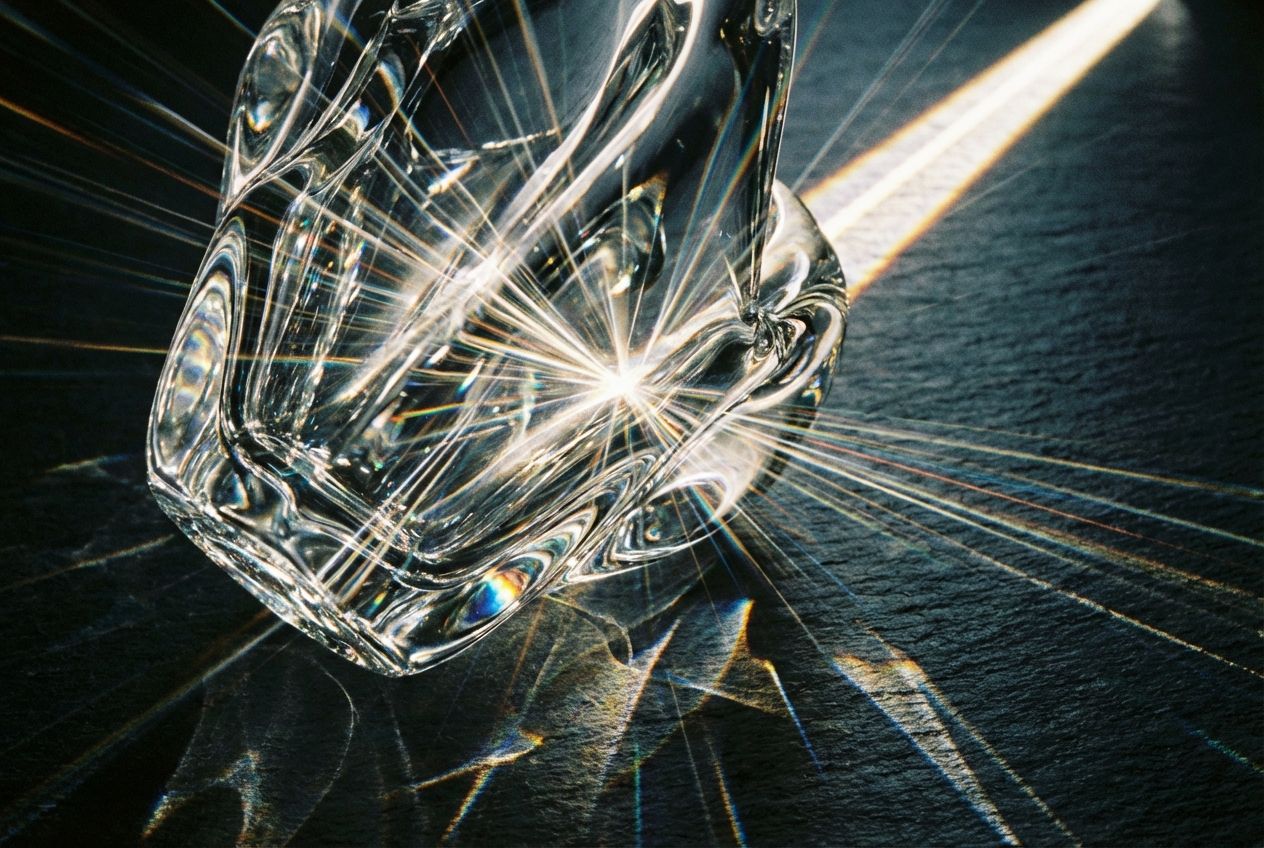
A striking, close-up photograph of a powerful beam of light intensely refracting and reflecting through a complex, clear sculpted glass object, creating a mesmerizing interplay of bright converging and diverging rays on a dark, textured background, composed for a 3:2 landscape frame.

Management & Tools

Deck Contents

32 Cards
Lesson#1
In this deck, we'll explore the fascinating world of light and lenses. We'll start by looking at how light reflects off different surfaces, and how it bends, or refracts, when it travels from one material to another. Then, we'll discover how convex and concave lenses work to form images. We'll also learn the crucial difference between real and virtual images. A key skill in this topic is drawing ray diagrams, which we'll explain conceptually. However, drawing them accurately is best learned with pen and paper, so we recommend practising this at a desk.
Lesson#2
Let's begin with reflection. When light hits a surface, it bounces off. The type of reflection depends on the surface. A very smooth surface, like a mirror, causes specular reflection. All the light rays bounce off at the same angle, creating a clear image. But a rough surface, like paper, causes diffuse reflection. The light rays scatter in all directions, which is why you can't see your reflection in a piece of paper.
Quiz#3
What is the term for reflection from a smooth surface where light rays reflect in a single direction?

specular reflection

Quiz#4
What is the term for reflection from a rough surface where light rays are scattered in many directions?

diffuse reflection

Lesson#5
For specular reflection, there is a simple rule called the law of reflection. It states that the angle of incidence is equal to the angle of reflection. The angle of incidence is the angle between the incoming ray and the normal, which is an imaginary line at a right angle to the surface. The angle of reflection is the angle between the reflected ray and the normal.
Quiz#6
According to the law of reflection, what is the relationship between the angle of incidence and the angle of reflection?

they are equal

Login to View Content

Create a free account or log in to see all 32 cards and start studying this deck.

Learn AQA GCSE Physics: Light and Lenses differently

Auracle is an audio-first learning platform built for busy people. Memorize anything without looking at a screen.

Hands-Free Learning

Listen, interact, and review cards entirely through audio. Perfect for commuting, walking, or at the gym.

Spaced Repetition

Auracle uses a scientific algorithm to schedule your reviews at the optimal time, ensuring you never forget what you learn.

Learn how it works

Ready to start the AQA GCSE Physics: Light and Lenses audio deck?