Tutorial

AQA GCSE Biology: Required Practical - Sampling Organisms

This deck details the required practical on ecological sampling. It covers how to use random sampling with quadrats to measure the population size of a species, and systematic sampling with a transect to investigate the effect of a factor on species distribution.
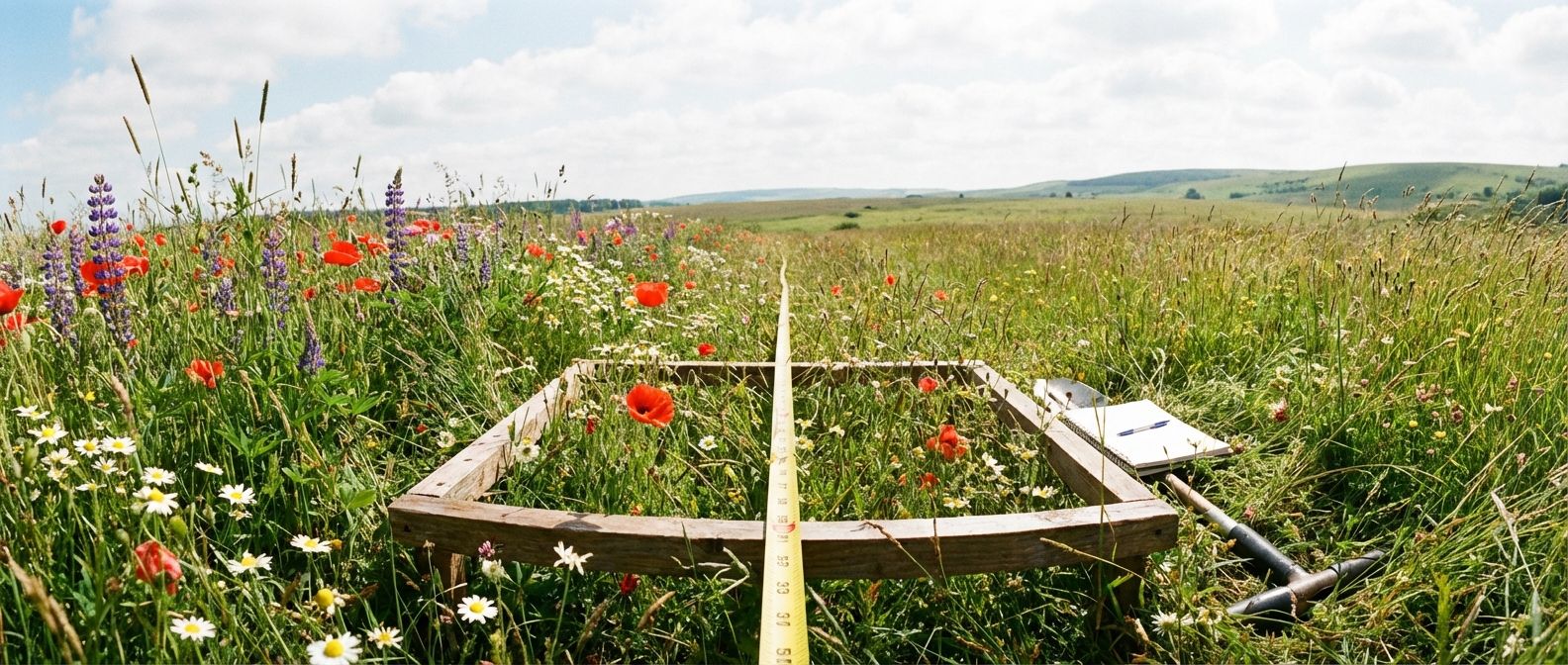
A wide, low-angle photograph of a sturdy wooden quadrat placed in a vibrant, sun-drenched meadow filled with wildflowers. A yellow measuring tape stretches across the foreground and into the distance, suggesting a scientific transect line. The scene captures the subtle transition from dense flora to a more open, grassy area under a bright sky, emphasizing ecological exploration.

Management & Tools

Deck Contents

23 Cards
Lesson#1
In this deck, we'll explore the required practical for sampling organisms. It's often impossible to count every single plant or animal in an area, so ecologists use sampling to estimate population sizes and see how species are distributed. We'll cover the two main techniques you need to know for your GCSE exam: random sampling with quadrats, and systematic sampling with transects.
Quiz#2
In ecology, why is sampling used instead of counting every organism?

to estimate population size

Quiz#3
What is the name of the square frame, typically made of wood or metal, used to sample plants and slow-moving animals?

quadrat

Lesson#4
Let's start with random sampling. You use this method when you want to estimate the population of a species in a large, fairly uniform area, like a school field. The key to random sampling is avoiding bias, which means you can't just throw your quadrat wherever you like. Instead, you need to be systematic about being random.
Quiz#5
For estimating the population of a species in a large, uniform area, what sampling method should be used?

random sampling

Lesson#6
To carry out random sampling, you first create a grid of the area. An easy way to do this is to lay two tape measures at right angles along two sides of the field. Then, you use a random number generator to create pairs of coordinates. You walk to these coordinates and place your quadrat down. You then carefully count the number of your target species inside the quadrat. You must repeat this process many times to get a reliable estimate.

Login to View Content

Create a free account or log in to see all 23 cards and start studying this deck.

Learn AQA GCSE Biology: Required Practical - Sampling Organisms differently

Auracle is an audio-first learning platform built for busy people. Memorize anything without looking at a screen.

Hands-Free Learning

Listen, interact, and review cards entirely through audio. Perfect for commuting, walking, or at the gym.

Spaced Repetition

Auracle uses a scientific algorithm to schedule your reviews at the optimal time, ensuring you never forget what you learn.

Learn how it works

Ready to start the AQA GCSE Biology: Required Practical - Sampling Organisms audio deck?