Tutorial

Human Personality and Destiny in Theravada and Mahayana Buddhism: AQA GCSE Religious Studies

Covers the Theravada account of human personality through the Five Aggregates, the Mahayana account through sunyata and Buddha-nature, and human destiny in both traditions including the Arhat ideal, the Bodhisattva ideal, full Buddhahood, and the Pure Land with Amitabha Buddha. Explicitly contrasts Theravada and Mahayana throughout as a high-priority exam comparison.
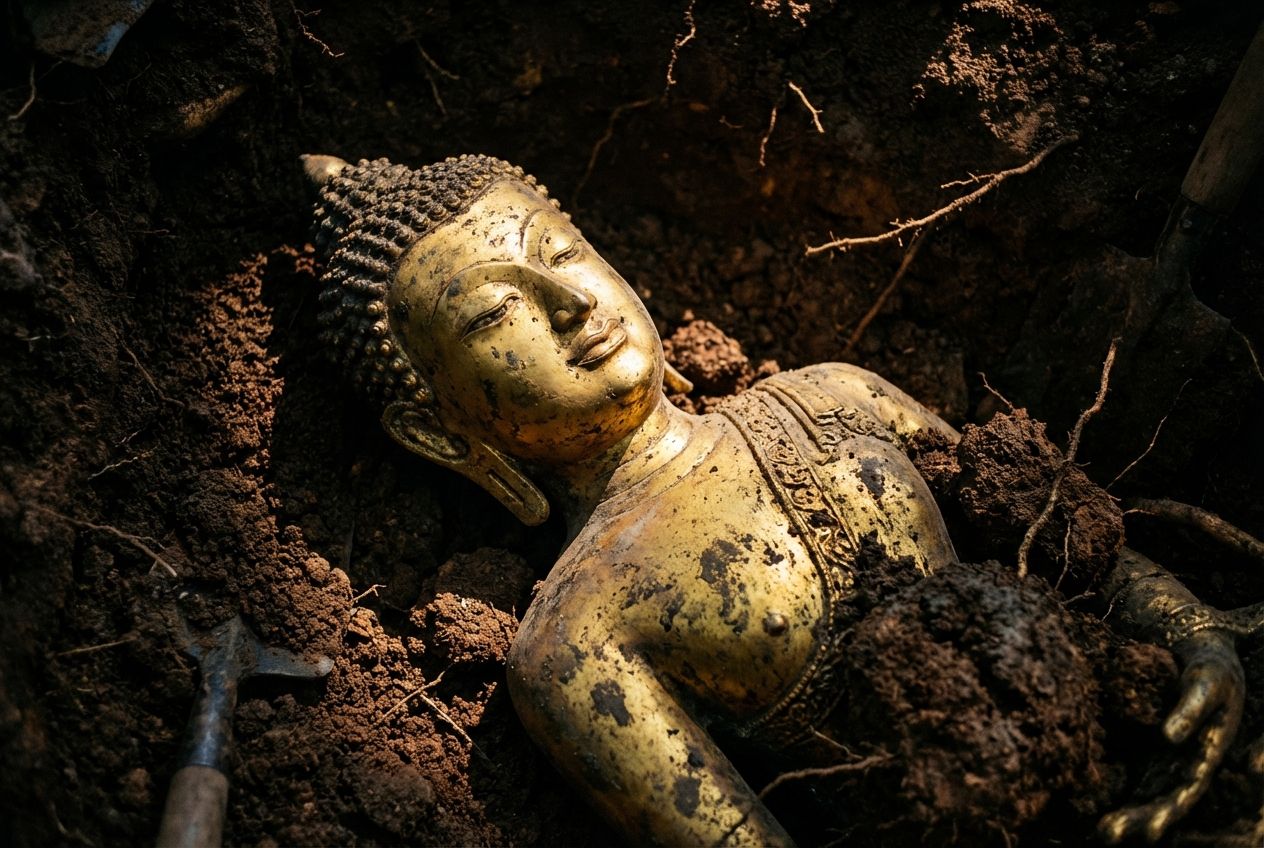
A dramatic, close-up photograph, composed for a 3:2 landscape frame, of a magnificent golden Buddha statue, partially unearthed from dark, rich soil. A focused beam of sunlight dramatically illuminates its serene face and intricate details, contrasting sharply with the rough, natural texture of the surrounding earth, symbolizing hidden potential and spiritual emergence.

Management & Tools

Deck Contents

45 Cards
Lesson#1
Welcome to this deck on human personality and destiny in Buddhism. This is one of the most important comparison topics in your AQA GCSE Religious Studies exam, because it asks you to contrast two major traditions: Theravada Buddhism and Mahayana Buddhism. The exam regularly asks you to evaluate statements about the self, the soul, and what happens to us after death, and to argue from both sides. By the end of this deck, you will know exactly what each tradition teaches about what a human being is, and what a human being can become. Let us start with the big question: what are you?
Lesson#2
In Theravada Buddhism, the question of what a human being is gets a very precise answer. There is no permanent soul, no unchanging self that travels through life and into the next. Instead, what we call a person is actually a collection of five constantly changing processes, bundled together and mistaken for a fixed self. These five processes are called the skandhas in Sanskrit, or khandhas in Pali. The word is sometimes translated as aggregates, or heaps. The idea is that a human being is not a thing but a process, like a flame that keeps burning without being the same flame from one moment to the next. This teaching is one of the most important in all of Buddhism, because it directly explains why we suffer and how we can be free.
Quiz#3
In Theravada Buddhism, what is the Pali term for the five components that make up a human being?

khandhas

Lesson#4
Let us go through the five aggregates one by one. The first is form, which in Pali is rupa. This is the physical body, the material dimension of a person, everything you can touch and see. The second is sensation, or vedana. This is not emotion in a complex sense, but the basic feeling tone of every experience: pleasant, unpleasant, or neutral. Every moment of experience has one of these three qualities. The third is perception, or sanna. This is the process of recognising and categorising what we experience, identifying a sound as a voice, a shape as a face. The fourth is mental formations, or sankhara. This is the broadest category and includes all our intentions, emotions, habits, and dispositions, everything that shapes how we respond to the world. The fifth is consciousness, or vinnana. This is awareness itself, the knowing quality that arises when a sense organ meets its object.
Quiz#5
What is the first of the Five Aggregates in Theravada Buddhism, referring to the physical body?

form

Quiz#6
What is the second of the Five Aggregates in Theravada Buddhism, referring to the basic feeling tone of pleasant, unpleasant, or neutral?

sensation

Login to View Content

Create a free account or log in to see all 45 cards and start studying this deck.

Learn Human Personality and Destiny in Theravada and Mahayana Buddhism: AQA GCSE Religious Studies differently

Auracle is an audio-first learning platform built for busy people. Memorize anything without looking at a screen.

Hands-Free Learning

Listen, interact, and review cards entirely through audio. Perfect for commuting, walking, or at the gym.

Spaced Repetition

Auracle uses a scientific algorithm to schedule your reviews at the optimal time, ensuring you never forget what you learn.

Learn how it works

Ready to start the Human Personality and Destiny in Theravada and Mahayana Buddhism: AQA GCSE Religious Studies audio deck?