Tutorial

AQA GCSE Chemistry: Use Moles in Calculations (Higher Tier)

Introduces the mole as a unit for the amount of substance. Covers calculations using mass, Mr, and moles. Explains how to use moles to balance equations and determine the limiting reactant in a reaction.
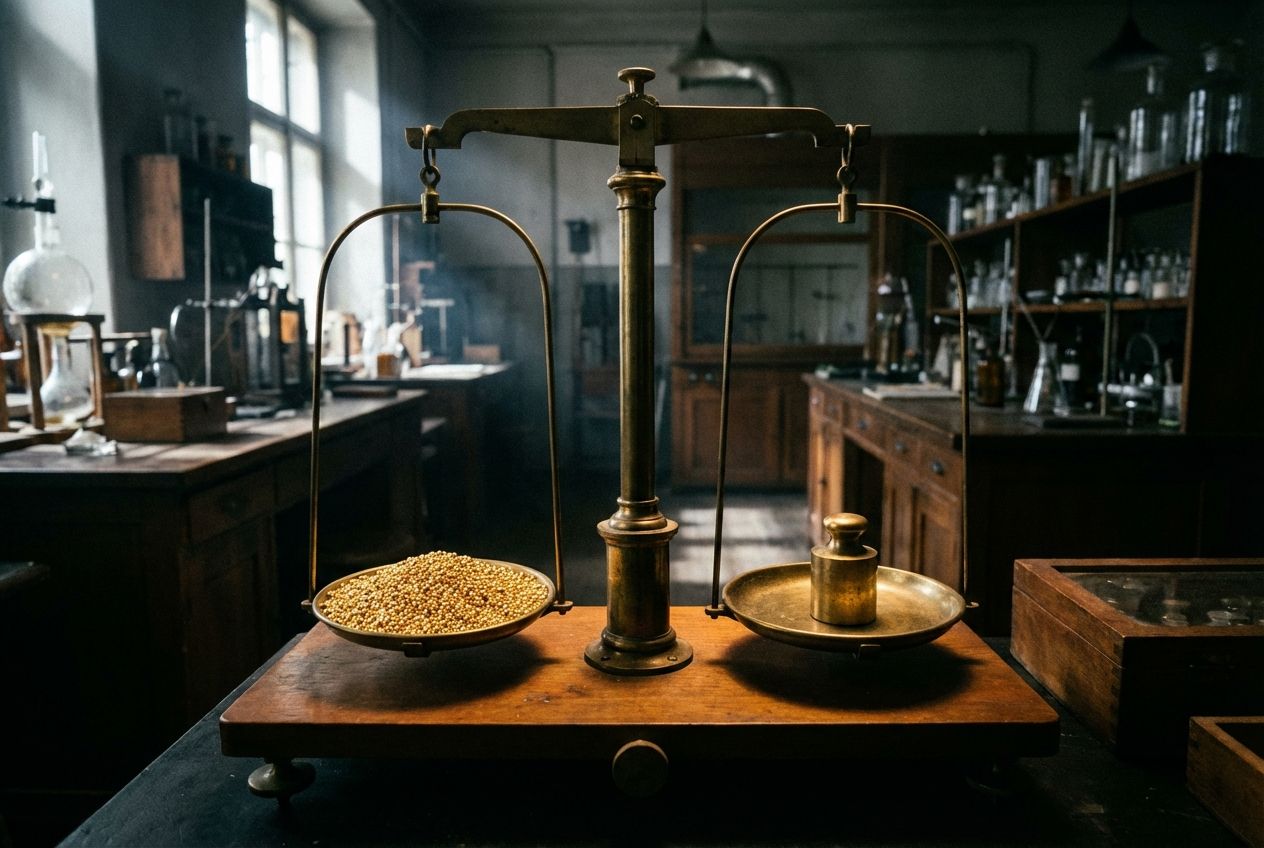
A dramatic, high-contrast photograph of a vintage analytical balance scale in an elegant, dimly lit laboratory setting. On one pan, a meticulously arranged, shimmering pile of countless tiny, identical, golden spheres, representing atoms or molecules. On the other pan, a single, precisely calibrated weight, perfectly balancing the vast quantity of spheres, emphasizing precision and the abstract nature of chemical measurement, composed for a 3:2 landscape frame with soft, focused lighting.

Management & Tools

Deck Contents

27 Cards
Lesson#1
Welcome to this deck on using moles in calculations. This is a Higher Tier topic in GCSE Chemistry. The mole is the chemist's unit for counting atoms, molecules, and ions. It allows us to scale up from the atomic level to the masses we can actually measure in a lab. In this deck, you'll learn what a mole is, how to calculate moles from a given mass, and how to use balanced equations to work out how much product a reaction will make. We'll also cover how to identify the limiting reactant, which is the chemical that runs out first and stops a reaction.
Quiz#2
In chemistry, what is the unit for the amount of a substance?

moles

Lesson#3
So, what exactly is a mole? Just like a 'dozen' means twelve of something, a 'mole' means a specific, very large number of particles. This number is called Avogadro's constant, and its value is 6.02 times 10 to the power of 23. So, one mole of carbon contains that many carbon atoms, and one mole of water contains that many water molecules. It's a huge number because atoms themselves are incredibly small.
Quiz#4
What is the name of the constant that represents the number of particles in one mole of a substance?

Avogadro's constant

Quiz#5
What is the value of Avogadro's constant?

6.02 times 10 to the power of 23

Lesson#6
For your exam, you won't usually need to use Avogadro's constant in calculations. Instead, you'll use a fundamental equation that links the mass of a substance, its relative formula mass, or Mr, and the number of moles. The equation is: mass equals moles multiplied by the relative formula mass. You'll need to be able to rearrange this to find any of the three values.

Login to View Content

Create a free account or log in to see all 27 cards and start studying this deck.

Learn AQA GCSE Chemistry: Use Moles in Calculations (Higher Tier) differently

Auracle is an audio-first learning platform built for busy people. Memorize anything without looking at a screen.

Hands-Free Learning

Listen, interact, and review cards entirely through audio. Perfect for commuting, walking, or at the gym.

Spaced Repetition

Auracle uses a scientific algorithm to schedule your reviews at the optimal time, ensuring you never forget what you learn.

Learn how it works

Ready to start the AQA GCSE Chemistry: Use Moles in Calculations (Higher Tier) audio deck?