GCSE Mathematics: Higher Tier (9-1)
This is the complete Higher Tier GCSE Maths syllabus, built for grades 7, 8, and 9. It covers all the content for AQA, Edexcel, and OCR.
GCSE Mathematics: Higher Tier (9-1)
This is the complete Higher Tier GCSE Maths syllabus, built for grades 7, 8, and 9. It covers all the content for AQA, Edexcel, and OCR.
Decks in this Course
52 items
GCSE Maths: Core Number Skills
Understand and apply the order of operations (BIDMAS), and work with integers, decimals, and fractions in calculations. This deck covers the foundational arithmetic skills needed for the entire course.

GCSE Maths: Factors, Multiples, and Primes
Define and identify factors, multiples, and prime numbers. Learn to use prime factor decomposition to find the Highest Common Factor (HCF) and Lowest Common Multiple (LCM) of two numbers.

GCSE Maths: Laws of Indices
Learn and apply the laws of indices for multiplication, division, powers, and zero, negative, and fractional indices to simplify and evaluate expressions.
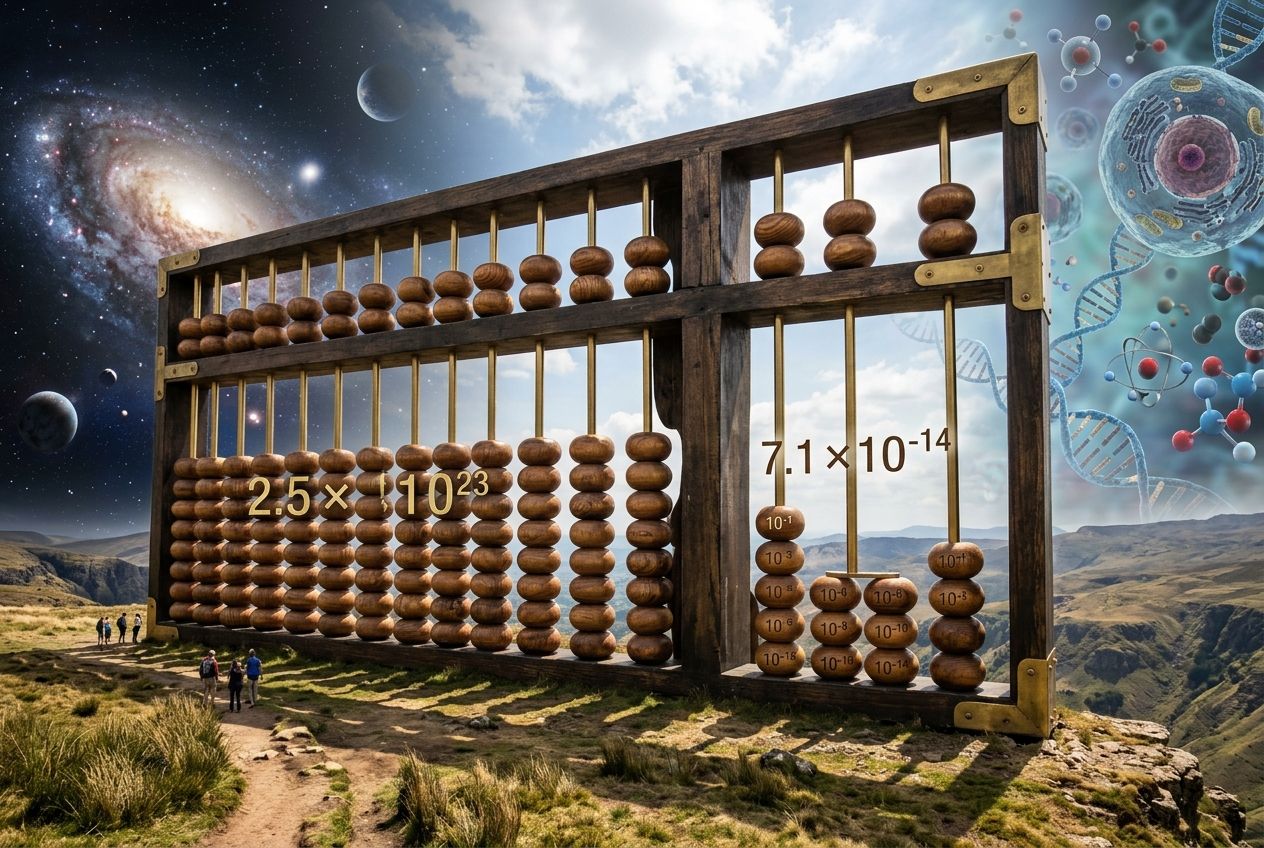
GCSE Maths: Standard Form
Learn to write large and small numbers in standard form, convert back to ordinary numbers, and perform calculations like multiplication, division, addition, and subtraction with them.
GCSE Maths: Understanding and Simplifying Surds
Understand what a surd is and learn the rules for simplifying surds, multiplying and dividing them, and expanding brackets containing surds.
GCSE Maths: Rationalising the Denominator
Learn the method for rationalising the denominator of a fraction, for both simple surd denominators and those involving two terms.
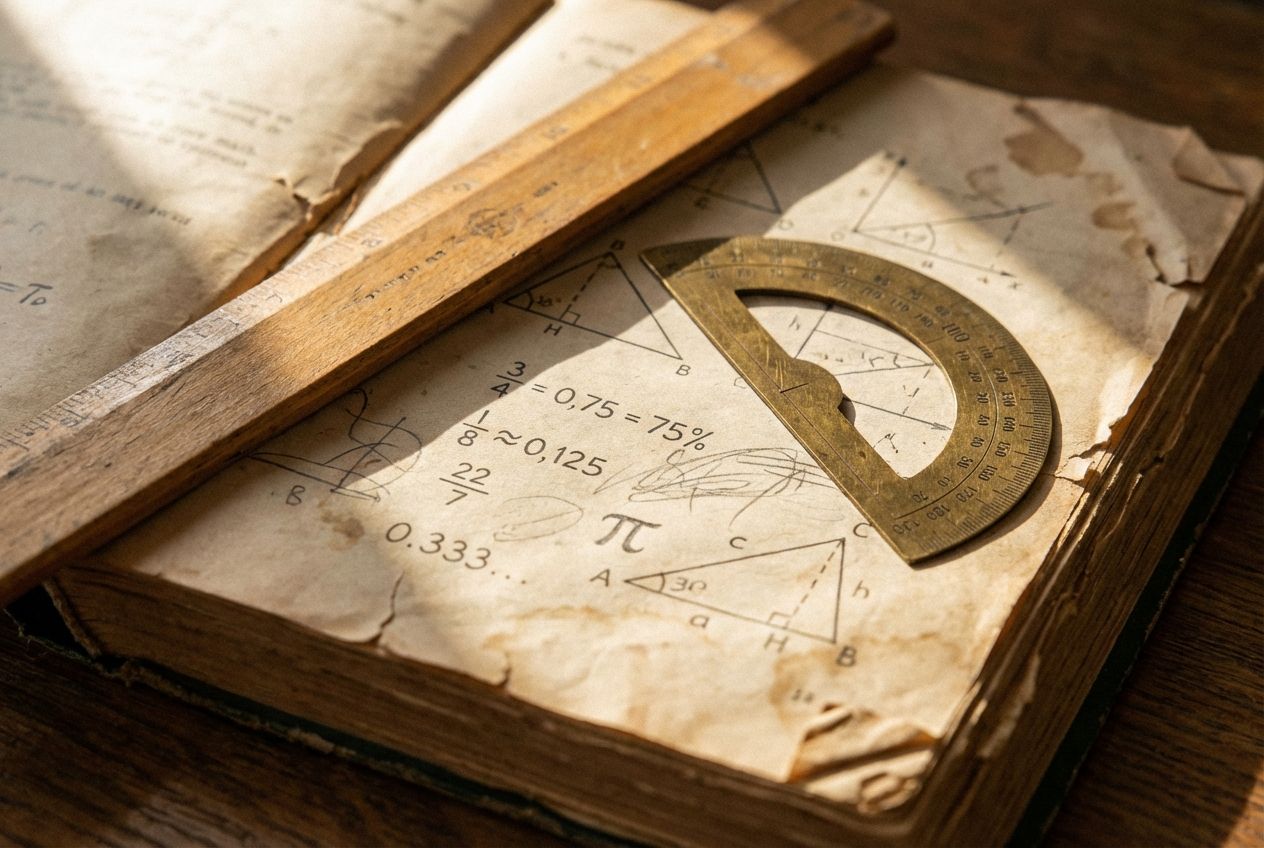
GCSE Maths: Fractions, Decimals, and Percentages
Master the conversion between fractions, decimals, and percentages, including the algebraic method for converting recurring decimals to fractions.

GCSE Maths: Percentage Change
Learn to calculate a percentage of an amount, find a percentage increase or decrease using multipliers, and solve reverse percentage problems.

GCSE Maths: Compound Growth and Decay
Understand the concept of compound interest and depreciation. Learn to use the formula to solve problems involving repeated percentage change.
GCSE Maths: Rounding, Bounds, and Error Intervals
Learn to round numbers to a given degree of accuracy and find the upper and lower bounds of a rounded number. Understand how to write an error interval.

GCSE Maths: Introduction to Algebra
Learn the fundamentals of algebra, including key notation like terms and expressions. This deck will teach you how to simplify expressions by collecting like terms and how to find the value of an expression by substituting numbers.
GCSE Maths: Expanding Brackets
Learn how to expand single brackets and pairs of brackets, including squaring a bracket and dealing with more complex expansions.

GCSE Maths: Factorising Expressions
Learn the process of factorising, which is the reverse of expanding. This deck covers factorising into a single bracket, the difference of two squares, and simple quadratic expressions.

GCSE Maths: Factorising Harder Quadratics
Learn the 'ac' method for factorising quadratic expressions of the form ax-squared plus bx plus c, where the coefficient of the squared term is greater than one.
GCSE Maths: Solving Linear Equations
Learn the methods for solving linear equations, including those with brackets, unknowns on both sides, and fractional terms.

GCSE Maths: Forming and Solving Equations
Learn how to translate word problems into algebraic equations and then solve them. This includes problems involving shapes, angles, and real-life scenarios.

GCSE Maths: Solving Quadratics by Factorising
Learn how to solve a quadratic equation by first factorising it. This deck covers rearranging the equation to equal zero, the principle of setting factors to zero, and finding the final solutions.
GCSE Maths: Completing the Square
Learn the method of completing the square to rewrite a quadratic expression in the form 'x plus a, all squared, plus b', and use this to find the turning point of a quadratic graph.
GCSE Maths: Solving Quadratics by Completing the Square
Learn how to solve a quadratic equation using the completed square form.
GCSE Maths: The Quadratic Formula
Learn the quadratic formula, understand its components like the discriminant, and know how to identify the values of a, b, and c from any quadratic equation. This deck prepares you to substitute values correctly and solve equations.

GCSE Maths: Solving Linear Simultaneous Equations
Learn to solve a pair of linear simultaneous equations to find the values of two unknown variables. This deck covers the graphical representation of a solution, and the two main algebraic methods: elimination and substitution.

GCSE Maths: Solving Non-Linear Simultaneous Equations
Learn how to solve simultaneous equations where one equation is linear and the other is quadratic. This deck covers the substitution method, how to form and solve the resulting quadratic equation, and how to find the corresponding pairs of solutions.

GCSE Maths: Linear Inequalities
Learn how to solve linear inequalities and represent the solution on a number line.

GCSE Maths: Quadratic Inequalities
Learn the method for solving quadratic inequalities by finding the roots and considering the shape of the quadratic graph.

GCSE Maths: Rearranging Formulae
Learn to change the subject of a formula, including those with brackets, fractions, and where the new subject appears more than once.
GCSE Maths: Algebraic Fractions
Learn how to simplify, add, subtract, multiply, and divide algebraic fractions, and solve equations involving them.
GCSE Maths: Sequences
Learn how to identify and find the term-to-term rule for different types of sequences. This deck covers finding the nth term formula for linear (arithmetic), quadratic, and geometric sequences.

GCSE Maths: Functions
Understand function notation, and learn how to find inverse functions and create composite functions.
GCSE Maths: Iteration
Learn how to find approximate solutions to complex equations using the process of iteration, including how to show a solution exists within a given interval.
GCSE Maths: Algebraic Proof
Learn the language and structure of algebraic proof, including how to prove results involving consecutive numbers, odd and even numbers.
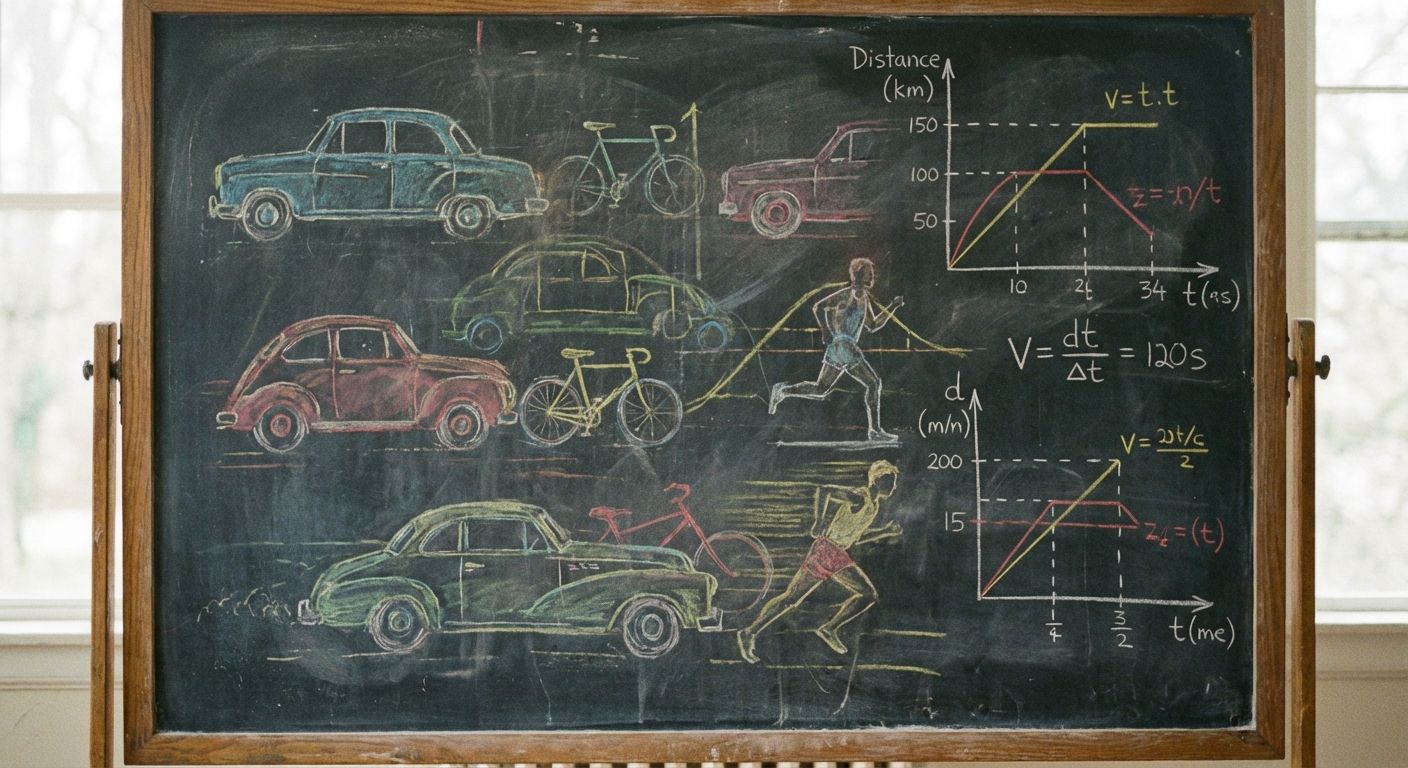
GCSE Maths: Coordinates and Linear Graphs
Learn to use coordinates in all four quadrants and understand the equation of a straight line, y=mx+c. You'll be able to identify the gradient and y-intercept, and know how to plot linear graphs.

GCSE Maths: Equations of Lines
Learn to find the equation of a straight line using its gradient and points. This deck covers the standard y = mx + c form, and the conditions for parallel and perpendicular lines, essential for GCSE Higher Tier.
GCSE Maths: Quadratic, Cubic, and Reciprocal Graphs
This deck introduces the shapes and key features of non-linear graphs. You will learn to recognise quadratic, cubic, and reciprocal graphs, and identify important points like roots, intercepts, and turning points.

GCSE Maths: Real-Life Graphs
Learn to interpret and use real-life graphs, focusing on distance-time graphs (for speed) and velocity-time graphs (for acceleration and distance travelled).
GCSE Maths: Advanced Graph Skills
Learn to use graphs to find approximate solutions to equations, estimate the gradient of a curve at a point, and estimate the area under a curve using the trapezium rule.

GCSE Maths: Graph Transformations
Learn how transformations affect the graph of a function, including translations, stretches, and reflections in the x and y axes.
GCSE Maths: Ratio and Proportion
Learn to simplify ratios, share amounts in a given ratio, and solve problems involving direct and inverse proportion.
GCSE Maths: Rates of Change
Learn to use and rearrange the formulae for speed, density, and pressure to solve problems.
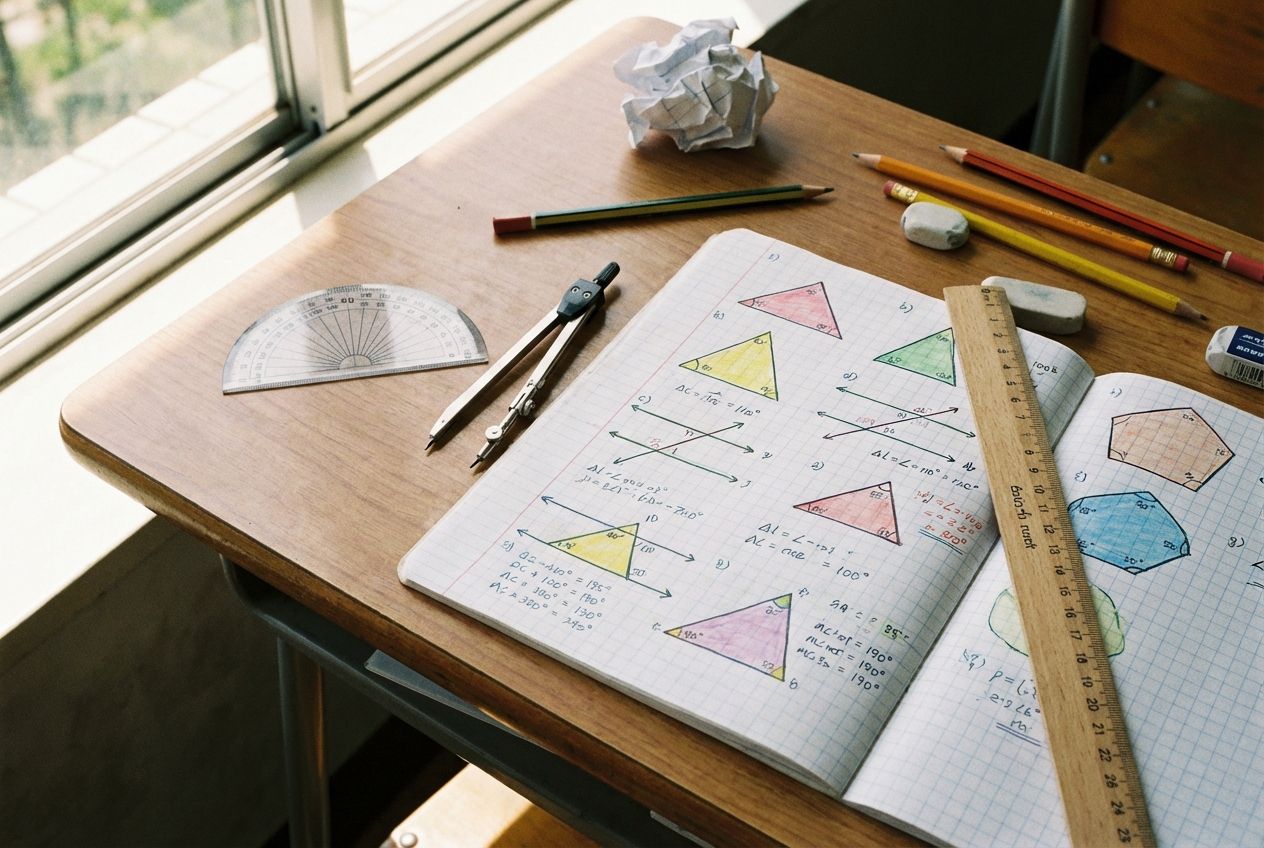
GCSE Maths: Angle Rules
Learn and apply the rules for angles at a point, on a straight line, in a triangle, and in parallel lines. Also covers angles in polygons.

GCSE Maths: Area and Perimeter
Learn the formulae and methods for calculating the area and perimeter of 2D shapes, including rectangles, triangles, parallelograms, trapeziums, and circles. This deck also covers strategies for compound shapes.
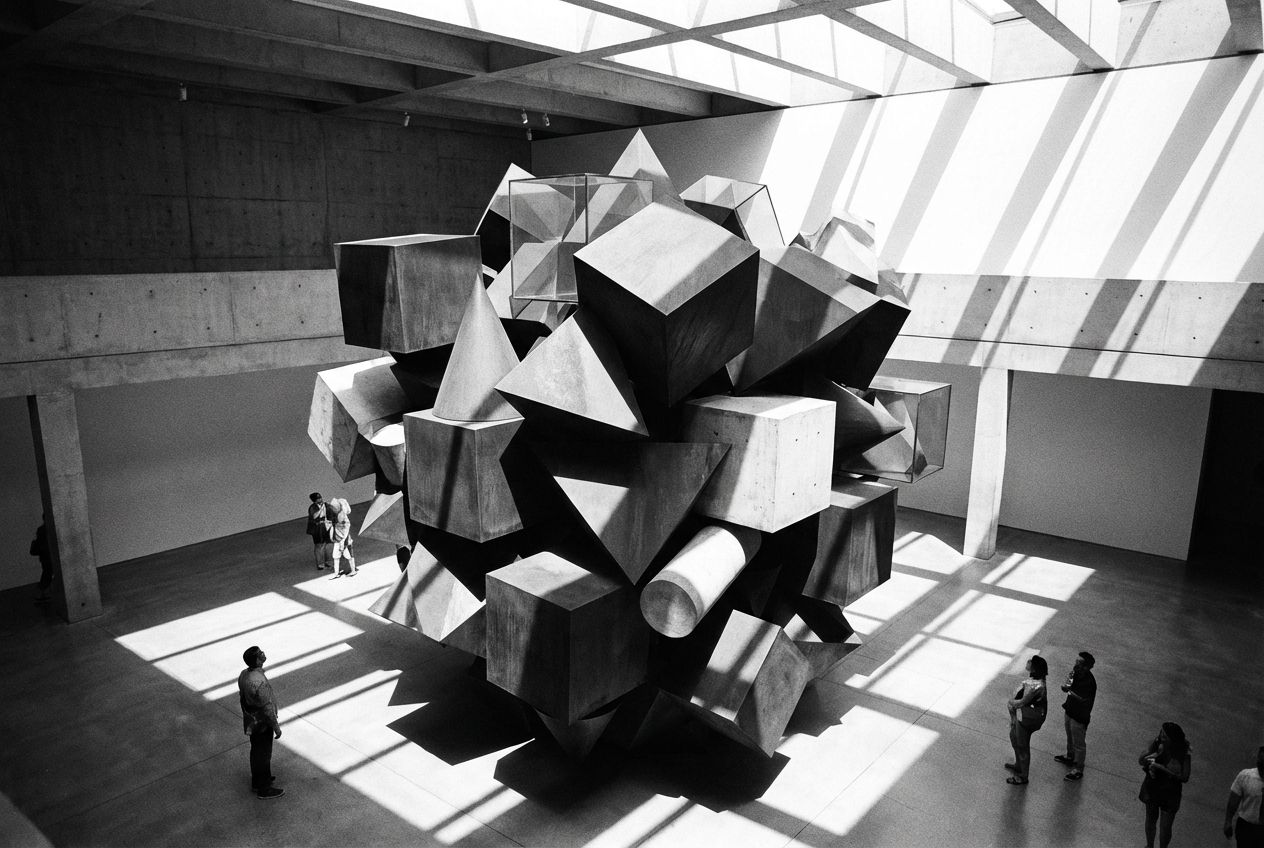
GCSE Maths: Volume and Surface Area of 3D Shapes
Learn the formulae for the volume and surface area of 3D shapes including cuboids, prisms, cylinders, pyramids, cones, and spheres.
GCSE Maths: Pythagoras' Theorem
Understand and apply Pythagoras' theorem to find the length of a missing side in a right-angled triangle in both 2D and 3D problems.

GCSE Maths: Right-Angled Trigonometry (SOHCAHTOA)
Learn the trigonometric ratios sine, cosine, and tangent, and use them to find missing sides and angles in right-angled triangles using the SOHCAHTOA mnemonic.
GCSE Maths: Advanced Trigonometry
Learn and apply the Sine Rule, Cosine Rule, and the formula 'Area equals one half a b sine C' to find missing sides, angles, and areas in any triangle.

GCSE Maths: Circle Theorems
Learn the main circle theorems and how to state them. This deck covers the rules for angles at the centre, angles in a semicircle, cyclic quadrilaterals, tangents, and the alternate segment theorem. Note: Applying these rules to diagrams requires desk practice.

GCSE Maths: Transformations
Learn to describe and perform the four transformations: reflection, rotation, translation, and enlargement (including with fractional and negative scale factors).

GCSE Maths: Vectors
Learn about vectors, a quantity with both magnitude and direction. This deck covers column vector notation, vector arithmetic including addition, subtraction and scalar multiplication, and how to apply these concepts to solve geometric problems and construct proofs about parallel lines and collinear points.

GCSE Maths: Probability Basics
Understand the probability scale from 0 to 1. Learn to calculate the probability of single events and combined events using probability trees and Venn diagrams.
GCSE Maths: Averages and Spread
Learn to calculate the mean, median, mode, and range from a list of data and from a frequency table. Also covers finding the interquartile range.

GCSE Maths: Representing Data
Learn to interpret and draw various statistical charts and graphs, including bar charts, pie charts, and scatter graphs. Understand correlation.
GCSE Maths: Cumulative Frequency and Box Plots
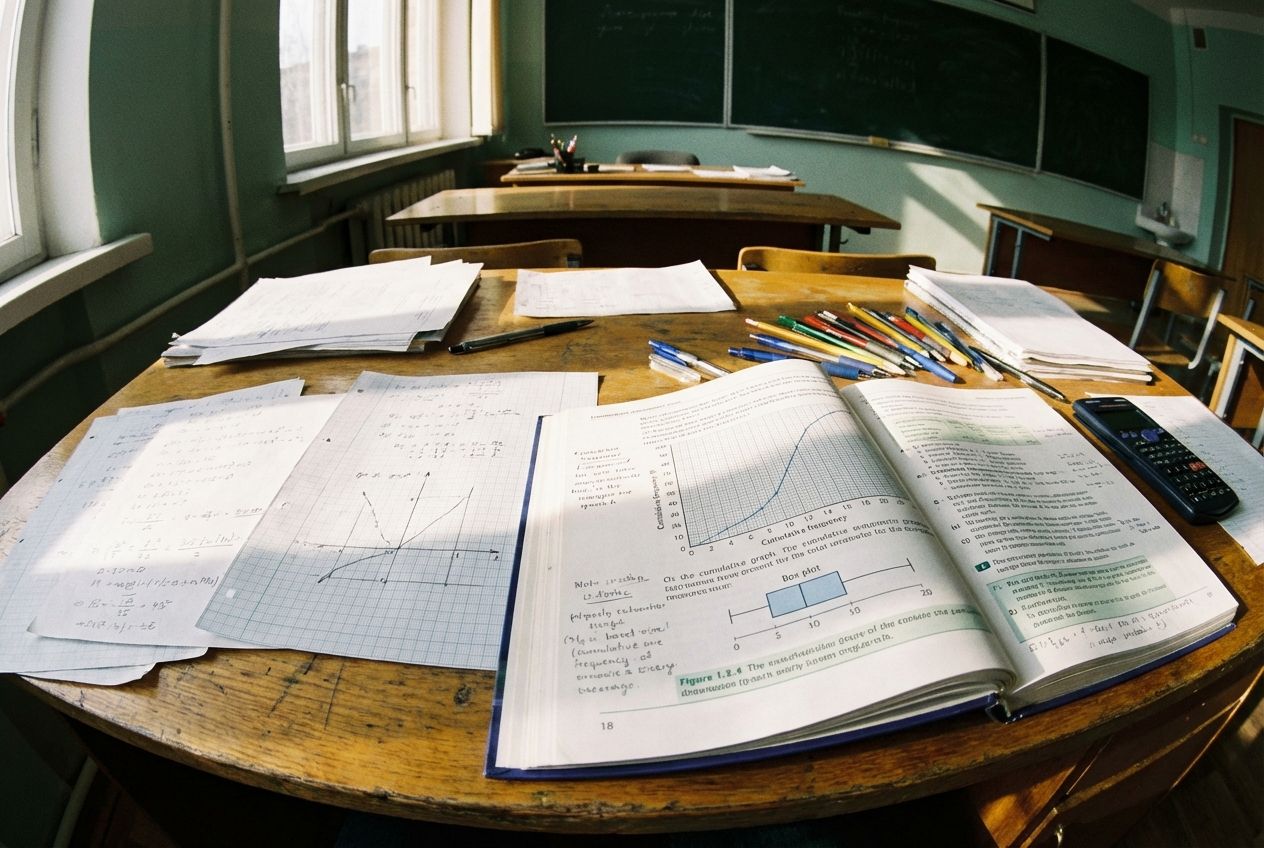
Learn to create and interpret cumulative frequency graphs to find estimates for the median and quartiles. Use these values to construct box plots and compare the distributions of different data sets.
GCSE Maths: Histograms
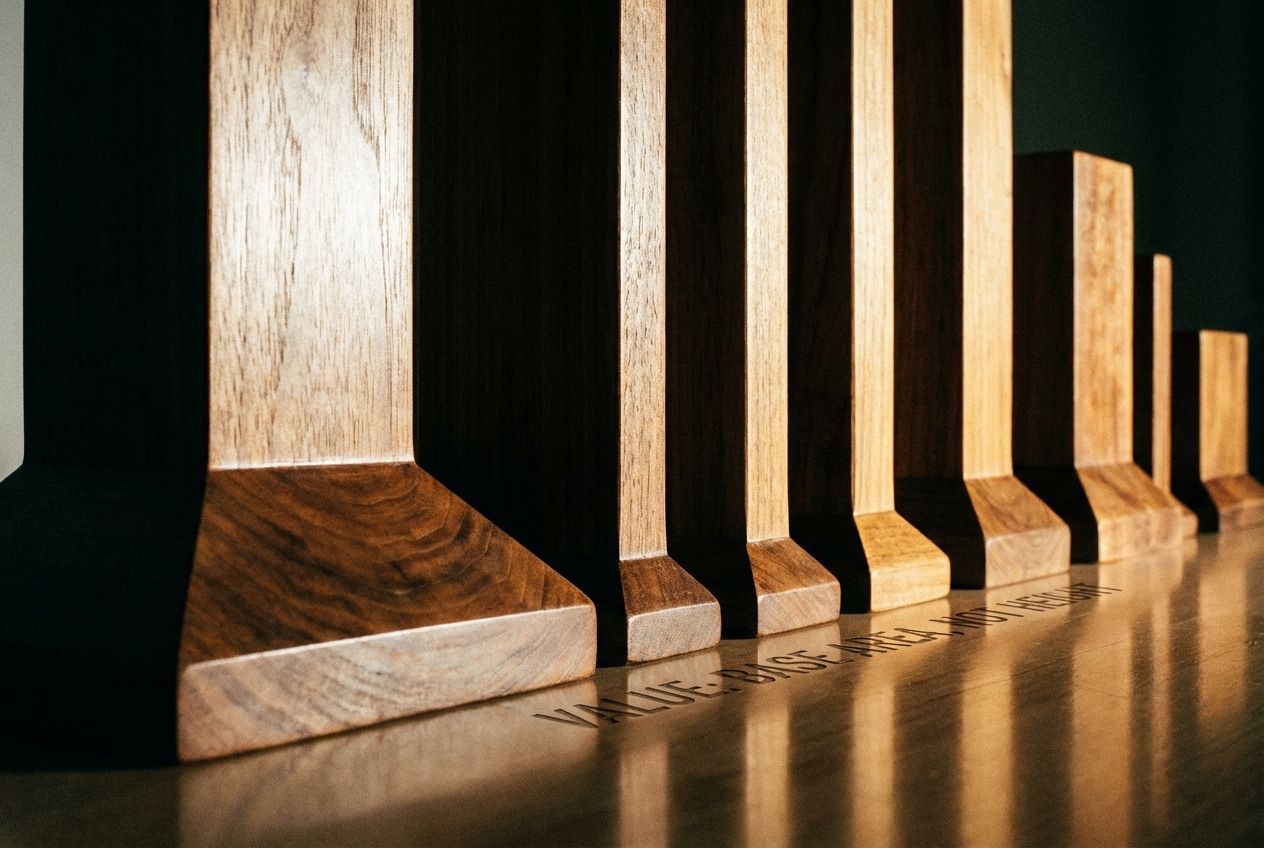
Learn when and why histograms are used instead of bar charts. This deck covers the key concept of frequency density, explaining how to calculate it and why it's essential for representing data with unequal class widths. You'll also learn how to interpret histograms by understanding that the area of each bar represents frequency.
Learn GCSE Mathematics: Higher Tier (9-1) differently
Auracle is an audio-first learning platform built for busy people. Memorize anything without looking at a screen.
Hands-Free Learning
Listen, interact, and review cards entirely through audio. Perfect for commuting, walking, or at the gym.
Spaced Repetition
Auracle uses a scientific algorithm to schedule your reviews at the optimal time, ensuring you never forget what you learn.
Learn how it works